

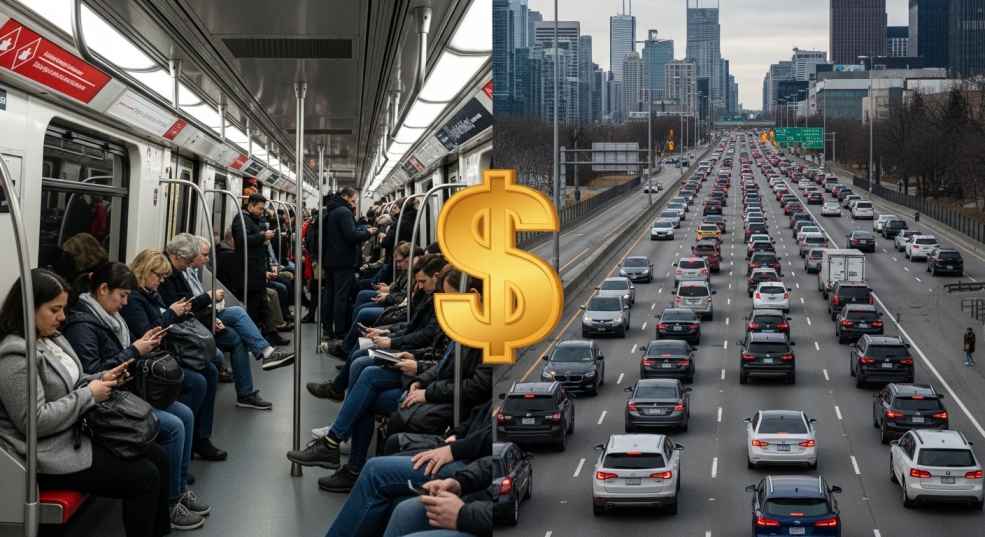
Here’s a number that should make every Canadian take pause: the average cost of owning and operating a car in Canada now runs approximately $1,373 per month — and in cities like Toronto, that figure climbs even higher, to $1,623 or more. A monthly transit pass in those same cities? As low as $97 in Montreal. That gap isn’t a rounding error. Over a year, we’re talking about a potential difference of $15,000 or more.
Of course, the real world is messy. If you live in a sprawling suburb with no bus stop in sight, a car isn’t a luxury — it’s a lifeline. But for millions of Canadians living in or near major urban centres, the question of whether to own a car deserves a much more honest financial examination than most of us give it.
In this article, we dig into the actual numbers behind public transit vs. car ownership across Canada’s biggest cities. We’ll compare real monthly and annual costs, highlight where the math shifts depending on where you live, and give you a practical framework for making the best decision for your wallet — and your lifestyle.
The True Cost of Car Ownership in Canada in 2025
Most people think about car costs in terms of their monthly payment. That’s understandable — it’s the biggest line item on the statement. But the full financial picture of car ownership in Canada is far more complex, and far more expensive, than that one number suggests.
Breaking Down What You Actually Pay
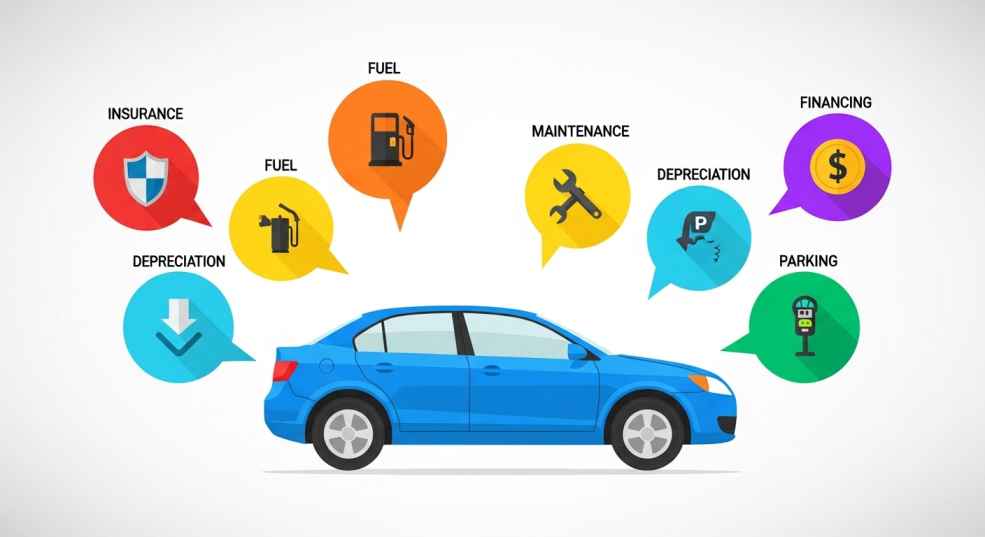
According to Ratehub.ca‘s detailed 2025/2026 analysis, the total cost of car ownership in Canada averages $1,373 per month. That factors in financing on an average new-car price of $63,264 (about $955/month at today’s rates), plus all ongoing expenses. Here’s what that looks like:
- Vehicle financing: ~$955/month (new car, 84-month term at ~6.45% APR)
- Auto insurance: ~$144–$164/month nationally (higher in Ontario at ~$160–$170/month)
- Fuel: ~$167/month based on ~$1.57/L national average and typical driving
- Maintenance and repairs: $80–$150/month (more as the vehicle ages)
- Depreciation: The most invisible cost — new vehicles lose 20–30% of value in year one
- Parking: $0 in rural areas to $200–$450/month in downtown Toronto or Vancouver
- Registration, licensing, tolls: Variable but often $50–$100/month equivalent
Thinking about buying used instead? That helps, but doesn’t solve the problem. Insurance costs remain similar, used-car loan rates are often higher, and maintenance costs go up as the vehicle ages. A good rule of thumb: even a paid-off used car still costs $600–$900/month when you account for insurance, gas, maintenance, and opportunity cost on the capital.
The Hidden Costs That Catch People Off Guard
Beyond the obvious line items, there are costs that most car owners don’t consciously track. Winter tires in Canada are essentially mandatory — budget $800–$1,200 for a set, plus installation fees twice a year. Urban parking tickets are a near-universal tax on city drivers. And then there’s the time cost: Statistics Canada reports that Toronto commuters lose 45+ hours a year to traffic congestion alone.
Ontario drivers face some of the highest insurance rates in the country — averaging around $1,920/year — while Quebec drivers pay as little as $900/year thanks to the province’s hybrid public-private insurance model. Where you live dramatically changes what you pay.
What Does Public Transit Actually Cost Across Canadian Cities?
Transit costs vary significantly depending on the city, and the relationship between price and service quality isn’t always intuitive. Toronto has the most expensive monthly pass in Canada — yet Vancouver’s multi-zone system can cost more for those who cross zones regularly.
Monthly Pass Prices by City (2025–2026)
Here’s a look at current monthly transit pass pricing across major Canadian cities, plus what that translates to in annual spending:
TABLE 2: Monthly Transit Pass Costs by City (2025–2026)
City | Monthly Transit Pass | Annual Cost | vs. Car Ownership (Annual Gap) |
Toronto (TTC) | $156 | $1,872 | Save ~$14,600–$17,600/yr |
Vancouver (TransLink) | $104.90–$189* | ~$1,259–$2,268 | Save ~$13,500–$17,200/yr |
Montreal (STM) | $97 | $1,164 | Save ~$15,300–$18,300/yr |
Calgary Transit | $118–$126* | $1,416–$1,512 | Save ~$14,000–$17,200/yr |
Ottawa (OC Transpo) | ~$120 | $1,440 | Save ~$13,900–$17,100/yr |
*Vancouver pass costs vary by zone. Calgary rates updated January 2026. Sources: TTC, TransLink, STM, Calgary Transit, OC Transpo.
Even in the most expensive transit city in Canada (Toronto at $156/month), a transit rider spends roughly 10% of what the average car owner spends. That’s a staggering ratio — and it’s the foundation of the entire financial argument for transit.
THE BOTTOM LINE
That said, it’s worth acknowledging that transit fares are rising. CBC News reported in late 2025 that Calgary, Ottawa, Edmonton, Victoria, and Vancouver all raised their fares, citing increased labour and operational costs. Transit isn’t getting cheaper — but it’s still dramatically more affordable than owning a car.
Head-to-Head: The Real Monthly and Annual Cost Comparison
Let’s put both options side by side in a direct comparison. The numbers below are based on national averages and current data; actual costs will vary based on your city, vehicle, and lifestyle.
TABLE 1: Public Transit vs. Car Ownership — Monthly Cost Breakdown (Canada, 2025)
Expense Category | Car Ownership (Avg.) | Public Transit (Avg.) | Annual Savings (Transit) |
Vehicle Payment / Financing | $955/mo | — | $11,460 |
Insurance | $144–$160/mo | — | $1,728–$1,920 |
Fuel (gas) | ~$167/mo | — | ~$2,000 |
Maintenance & Repairs | $80–$150/mo | — | $960–$1,800 |
Parking (urban avg.) | $100–$450/mo | — | $1,200–$5,400 |
Monthly Transit Pass | — | $91–$156/mo | — |
TOTAL (estimated monthly) | $1,373–$1,623+ | $91–$156 | $14,000–$18,000+/yr |
Sources: Ratehub.ca (2025/2026 car ownership data), Buckler Insurance (insurance rates), C For Cars (fuel and maintenance), city transit authority websites.
What could you do with $14,000–$17,000 in extra savings each year? For context: that’s roughly a 5–10% down payment on a Toronto condo, fully maxed TFSA contributions for the year, or an international trip every month. The opportunity cost of car ownership is enormous, and most Canadians never fully internalize it.
When the Math Changes: Scenarios Where a Car Makes More Sense
It would be intellectually dishonest to argue that public transit is the right choice for every Canadian. The reality is more nuanced, and the right answer depends heavily on where you live and how you live.
The Suburban and Rural Reality
As the Institute for Research on Public Policy notes, Canadians face an ‘affordability paradox’: lower-cost housing often exists on the urban fringe, precisely where transit service is weakest. If you’re living in a suburb of Calgary, a smaller Ontario city, or anywhere rural, a car is often simply not optional. The infrastructure wasn’t built for transit dependence, and that’s not changing overnight.
In these contexts, the question isn’t transit vs. car — it’s how to minimize car ownership costs. Buying used, driving less, combining car-sharing services for occasional urban trips, and shopping insurance aggressively can shave hundreds off the monthly bill.
Families, Kids, and the Logistics of Real Life
A single downtown professional making daily subway commutes is an easy case for transit. A family of four running three kids to hockey practice, piano lessons, and suburban soccer at 6 AM on a Saturday is not. Transit simply cannot replicate the convenience of door-to-door family logistics in most Canadian cities.
The smart play for many families? One car instead of two. Using transit for the primary commute reduces the burden on a single family vehicle dramatically, potentially eliminating the need for a second car entirely — a saving of $1,373+ per month.
The Case for a Hybrid Approach
Many Canadians are discovering that the real financial win isn’t “transit only” — it’s “transit-first.” Use transit for your daily commute (by far the highest-frequency use case for most city dwellers), and supplement with car-sharing platforms like Communauto, Zipcar, or Turo for weekend trips, Costco runs, or cottage getaways.

In Toronto, for example, Communauto offers cars for as little as $7/hour or $52/day — far cheaper than a second car for the handful of times a month you actually need one. When you run the numbers, a transit pass plus occasional car-share often comes in at $300–$400/month total, compared to $1,373+ for full ownership.
Environmental and Time Cost: The Other Side of the Ledger
The financial comparison is compelling on its own. But for many Canadians, the calculus of transit vs. car extends beyond dollars.
Environmental Impact
The environmental case for transit is substantial. Riding the TTC cuts individual greenhouse gas emissions by an estimated 79% compared to driving a car. Statistics show that transportation accounts for roughly 33% of Toronto’s total emissions, with solo vehicle use being the dominant contributor. A $30 billion federal commitment over 10 years through the Canada Public Transit Fund signals that investment in transit infrastructure isn’t slowing down.
Time: The Commute You Can Actually Use
There’s a common assumption that transit is always slower than driving. In dense urban cores during peak hours, that’s increasingly untrue — but more importantly, transit time is usable time. The average Toronto car commuter loses 45+ hours a year to traffic and cannot use that time productively. A transit rider can read, work, listen to podcasts, or simply decompress. That asymmetry matters for quality of life, even if it doesn’t show up on a balance sheet.
Actionable Takeaways: How to Optimize Your Transportation Costs
Whether you’re fully committed to transit, firmly attached to your car, or somewhere in between, here are practical steps to minimize what you spend on getting around in Canada:
If You’re Considering Ditching Your Car (or Second Car)
- Run your own numbers first: calculate your actual monthly car costs including insurance, gas, parking, and maintenance — most people are surprised how high it is.
- Test a transit month: commit to transit for 30 days before making any permanent decisions. Track convenience, time, and actual costs.
- Price out car-sharing in your city: Communauto (Quebec and Ontario), Zipcar, or Turo can cover the gaps that transit doesn’t fill.
- Check employer transit benefits: Many Canadian employers offer transit subsidy programs or pre-tax commuter benefits.
If You Need to Keep Your Car
- Shop insurance every year — loyalty rarely pays in the Canadian auto insurance market. Even switching companies every 2–3 years can save $300–$500 annually.
- Consider a used vehicle: buying two to three years old eliminates the steepest depreciation curve while keeping reliability high.
- Use transit for your commute even if you keep the car: reducing daily driving dramatically cuts fuel and wear-and-tear costs, and may lower your insurance premium.
- Bundle home and auto insurance: most major Canadian insurers offer 10–25% discounts for bundled policies.
The Smart Middle Path for Urban Canadians
- Transit pass + car-share = ~$300–$400/month total (vs. $1,373+ for full ownership)
- Avoid downtown parking costs entirely — the biggest wildcard in the urban cost equation
- Factor in the investment opportunity: the $14,000+ saved annually invested at average market returns compounds dramatically over a career
The Verdict: Public Transit Wins on Cost — But Context Is Everything
The numbers don’t lie. For Canadians living in or near major cities with functioning transit systems, choosing public transit over car ownership can save anywhere from $14,000 to $18,000 per year. That’s not a small rounding difference — that’s the kind of money that can change retirement timelines, eliminate debt, or fund genuine financial freedom.
But personal finance is personal. The “best” transportation decision for a single downtown professional in Montreal is completely different from what makes sense for a family of four in suburban Mississauga. The goal shouldn’t be to justify a predetermined conclusion — it should be to make sure you’re looking at all the real costs before you decide.
Key takeaways from this comparison:
- The average Canadian car owner spends $1,373–$1,623+ per month on vehicle costs — most significantly underestimate this number.
- Monthly transit passes range from $97 (Montreal) to $156 (Toronto) — roughly 10% of car ownership costs.
- The annual savings of choosing transit over car ownership in a major Canadian city ranges from $14,000 to $18,000.
- Transit fares are rising across Canada, but remain a fraction of car costs.
- A “transit-first” hybrid approach (transit pass + occasional car-share) offers the best value for most urban Canadians.
- Rural and suburban Canadians may have limited transit options, but can still reduce car costs through smart insurance shopping, used-vehicle purchases, and trip consolidation.
The frugal living bottom line: every time you swipe a transit card instead of starting an engine, you’re making a financial choice that compounds over time. Run your numbers. Challenge your assumptions. The most expensive vehicle in your life might be the one sitting in your driveway.
