

If you’ve been watching your rent creep upward for the past few years, here’s some genuinely good news: Canada’s rental market has finally started cooling. After a brutal run of 8–12% annual increases between 2020 and 2023, national average asking rents dropped to approximately $2,123/month by late 2025 — marking 12 consecutive months of decline heading into 2026. (Source: Neobanc, January 2026)
But here’s the thing — that national average tells only part of the story. While renters in Toronto and Vancouver are still shelling out north of $2,600 for a one-bedroom, there are cities across this country where you can rent a comfortable apartment for under $1,100 a month. The gap is staggering, and if you have any flexibility at all — whether you’re a remote worker, a recent grad, a new immigrant, or just someone tired of spending half your paycheque on housing — knowing where those affordable cities are could genuinely change your financial life.
In this guide, we break it all down province by province. We’ll look at real rental data, highlight the standout affordable cities in each region, and give you the practical context you need to decide if a move makes sense. Whether you’re staying in your province or willing to cross borders, there’s a city here that might surprise you.
Let’s get into it.
The Big Picture: Canada’s Rental Market in 2026
Before diving into specifics, it helps to understand the forces shaping rents right now.
Canada’s vacancy rate reached 3.1% in 2025 — its highest in over a decade and up from 2.2% the prior year. (Source: CMHC) More available units means more negotiating power for tenants. This is especially true in cities that saw a surge of new purpose-built rental construction between 2022 and 2024.
At the same time, the federal government scaled back immigration targets for 2025, which reduced rental demand pressure in several major markets. Non-permanent resident outflows from Ontario alone increased by 66.5% in 2024 compared to 2023. The result? Softening demand in the cities that had been tightest.
The market is cooling — but it’s not doing so equally everywhere. And that’s exactly why a province-by-province breakdown matters.
Province-by-Province Breakdown: Where Rent Is Actually Affordable
Quebec: Canada’s Most Affordable Province for Renters
Quebec deserves the top spot on this list, and it’s not particularly close. Multiple cities in the province consistently rank among the cheapest places to rent in all of Canada, and the numbers back it up.
Trois-Rivières — The Frugal Living Champion
If budget is your primary concern, Trois-Rivières is your city. Sitting roughly halfway between Montreal and Quebec City on the St. Lawrence River, this mid-sized city of about 140,000 regularly earns the title of Canada’s most affordable sizable town. Average monthly rents hover between $700 and $900 CAD for a one-bedroom apartment, with overall monthly living expenses often coming in under $1,100. (Source: Moving2Canada, 2025)
The trade-off? Most daily life happens in French, and the job market is smaller than in major centres — though remote workers find it extremely attractive. For students, retirees, and location-independent professionals, it genuinely doesn’t get much cheaper.
Sherbrooke — Affordable, Bilingual, and Underrated
Sherbrooke is another Quebec gem that doesn’t get enough attention in national conversations about affordability. With average one-bedroom rents around $1,100–$1,250/month, it offers a more bilingual environment than Trois-Rivières and a vibrant university-town culture that keeps the city lively year-round. (Source: Liv.rent, 2025)
The strong student population helps keep rental stock plentiful and prices competitive. You’ll find everything you need in terms of services, healthcare, and recreation — for a fraction of what you’d pay in Montreal.
Drummondville — Quiet, Affordable, Surprisingly Convenient
Drummondville tends to fly under the radar, but a two-bedroom apartment here averaged around $1,200/month in early 2025 — one of the lowest asking rents for a two-bedroom in any Canadian metro area. (Source: Taxes for Expats, 2025) It’s within commuting distance of Montreal and has a growing manufacturing base for those who need local employment.
Saskatchewan: Prairie Affordability with Big-City Amenities
Saskatchewan might not be the first province that comes to mind when you think “affordable living,” but it consistently punches above its weight in rental value.
Regina — Canada’s Most Affordable Major City for Renters
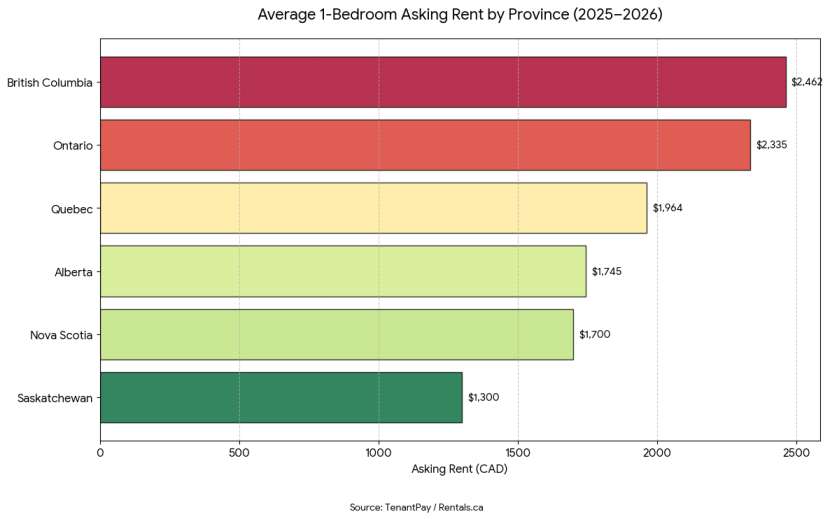
Regina is arguably the most affordable provincial capital in Canada for renters, full stop. The RBC 2025 Housing Affordability Report tagged Regina as the most affordable major market in the country. (Source: RBC Economics) Average one-bedroom rents sit around $1,299/month, and the average home price is just over $307,000 — making it a rare city where renting can genuinely be a stepping stone to ownership rather than a trap. (Source: Narcity, December 2025)
Regina also has some of Canada’s lowest property tax rates for a mid-sized city, which matters if you eventually plan to buy. The economy is diversified across manufacturing, agriculture, food processing, and oil and gas — meaning jobs are available across a range of sectors.
Saskatoon — Slightly Pricier, but Still Very Affordable
Saskatoon tends to run a bit higher than Regina in rental costs, but it remains well below the national average. The city has a younger demographic, a strong university presence, and a growing tech sector that’s been attracting remote workers and skilled professionals. Expect to pay roughly $1,300–$1,450/month for a one-bedroom in most neighbourhoods.
New Brunswick: East Coast Value Without the East Coast Price Tag
New Brunswick is one of Canada’s best-kept secrets for affordable living, and the rental data supports the case.
Moncton — Growing Fast, Still Affordable
Moncton has been one of Atlantic Canada’s fastest-growing cities over the past decade, yet it has managed to keep rental costs remarkably reasonable. Average one-bedroom rents hover around $1,100/month, making it competitive with much of Quebec. (Source: Liv.rent, 2025)
The city is officially bilingual (French and English), which is a genuine advantage for job seekers in federal services and private business alike. Its central location in the Maritimes makes it a convenient hub, and the city has been attracting remote workers and young families priced out of Halifax and Ontario.
Fredericton — Best Quality of Life Per Dollar in Atlantic Canada
Fredericton topped MovingWaldo’s 2025 list of cheapest cities in Canada with the best quality of life, and it’s easy to see why. One-bedroom rents average around $1,464/month, and the average home price sits at roughly $345,100. (Source: Narcity, December 2025) For a provincial capital with historic architecture, a lively arts scene, strong healthcare, and outdoor access that most Canadians would envy, that’s an exceptional value proposition.
📊 COMPARISON TABLE 1 — Cheapest Cities to Rent in Canada by Province (2026)
| City | Province | Avg. 1-BR Rent | Avg. Home Price | Best For |
|---|---|---|---|---|
| Trois-Rivières | Quebec | ~$800–$900 | ~$270,000 | Budget-first renters, students |
| Drummondville | Quebec | ~$1,000–$1,100 | ~$280,000 | Quiet living near Montreal |
| Sherbrooke | Quebec | ~$1,100–$1,250 | ~$290,000 | Students, bilingual workers |
| Moncton | New Brunswick | ~$1,100 | ~$300,000 | Young families, bilingual speakers |
| Regina | Saskatchewan | ~$1,299 | ~$307,000 | Career starters, future buyers |
| Saskatoon | Saskatchewan | ~$1,350–$1,450 | ~$340,000 | Tech workers, young professionals |
| Fredericton | New Brunswick | ~$1,464 | ~$345,100 | Quality of life seekers |
| St. John’s | Newfoundland & Labrador | ~$1,270 | ~$330,000 | Community-oriented renters |
| Windsor | Ontario | ~$1,300–$1,400 | ~$350,000 | Ontario renters on a budget |
| Edmonton | Alberta | ~$1,200–$1,400 | ~$380,000 | Career-driven, no provincial tax |
Sources: Numbeo (May 2025), Rentals.ca, Moving2Canada, Narcity/MovingWaldo 2025. Rents are approximate asking rents for 1-bedroom units.
Newfoundland and Labrador: Canada’s Easternmost Bargain
St. John’s — Character, Community, and Comparatively Low Rents
St. John’s is one of those cities that tends to surprise people. Known for its colourful row houses, wild weather, and famously warm community spirit, it also happens to be one of the more affordable cities in English Canada. A one-bedroom apartment in the city centre averages $1,270/month, while units outside downtown drop to around $1,000/month. (Source: Moving2Canada, 2025)
One caveat worth noting: the unemployment rate in St. John’s sits higher than the national average (around 9.4% as of late 2024), and walkability scores are relatively low. It’s a great fit for remote workers and retirees, but job seekers should research their specific industry before making the move.
Alberta: No Provincial Income Tax, Surprisingly Affordable Rents
Alberta’s big selling point beyond rent is its tax environment — there’s no provincial income or sales tax, which materially increases your take-home pay compared to most other provinces. That makes even slightly higher nominal rents feel more affordable in practice.
Edmonton — Big City, Budget-Friendly Price Tag
Edmonton is one of Canada’s largest cities, yet it consistently offers rents well below the national average for urban centres of comparable size. One-bedroom apartments typically run $1,200–$1,400/month, with plenty of options below that in outer neighbourhoods. The city’s oil and gas economy has historically supported strong wages, making the rent-to-income ratio quite favourable.
The provincial average rental cost sits at approximately $1,745/month (Source: TenantPay, 2025), but Edmonton pulls that number down considerably compared to Calgary, which has seen more pressure from urban migration.

Ontario: Expensive Province, But There Are Hidden Pockets of Affordability
Ontario’s provincial average asking rent is approximately $2,335/month — well above the national average and second only to British Columbia. (Source: TenantPay, 2025) But averages can be misleading. Several Ontario cities offer rents that are genuinely competitive.
Windsor — Ontario’s Most Affordable Rental City
Windsor, at Canada’s southernmost tip across the river from Detroit, Michigan, offers some of the most affordable rents in the province. One-bedroom units typically run $1,300–$1,400/month, well below the Ontario average. (Source: HousingForHouston, 2025) The city’s automotive sector provides stable employment, and its warm climate (by Canadian standards) is a genuine bonus.
Sarnia — A Quieter Alternative with Lower Rents
Sarnia sits on Lake Huron and offers rents around $1,659/month for one-bedrooms — considerably cheaper than London, Hamilton, or Ottawa, and a world away from Toronto prices. It’s a smaller city with a strong petrochemical and manufacturing base. Not for everyone, but for the right person it represents real value inside an expensive province.
Nova Scotia: Growing Pains, But Worth Keeping on Your Radar
Halifax has seen significant population growth in recent years, which pushed rents up sharply — average one-bedrooms now cost around $1,670–$2,100/month depending on location. (Source: Moving2Canada, 2025) It’s a beautiful city with strong quality of life, but it’s no longer the affordability haven it once was.
However, Nova Scotia’s provincial HST dropped to 14% as of April 2025, providing some cost-of-living relief for everyday purchases. And outside Halifax, smaller Nova Scotia communities still offer substantially lower rents — though job markets are thinner.
Key Takeaways: What to Consider Beyond the Rent Number
Rent is the biggest variable — but it’s not the only one. Here’s what smart frugal movers factor in:
Job market depth. Trois-Rivières is dirt cheap, but if you need on-site employment in a specific field, the options may be limited. Remote workers have far more geographic flexibility.
Language requirements. Quebec’s most affordable cities are predominantly francophone. If you’re not fluent in French, Moncton (bilingual), St. John’s, Regina, or Edmonton may be better fits.
Tax environment. Alberta has no provincial income or sales tax. Quebec has both provincial income tax and a 9.975% QST on top of federal GST. The nominal rent savings in Quebec can be partially offset depending on your income bracket.
Vacancy rates and negotiating power. With national vacancy rates at a decade high, renters in 2026 have more leverage than they’ve had in years. This is especially true in cities that saw heavy condo construction — don’t be afraid to negotiate on price or ask for incentives like a free month’s rent.
Total cost of living. A city with $900/month rent but $400/month car expenses (due to poor transit) might not be as cheap as a city with $1,400 rent and reliable public transit.
📊 COMPARISON TABLE 2 — Rent Savings vs. Toronto (Monthly)
| City | Avg. 1-BR Rent | Monthly Savings vs. Toronto (~$2,600) | Annual Savings |
|---|---|---|---|
| Trois-Rivières | ~$850 | ~$1,750 | ~$21,000 |
| Moncton | ~$1,100 | ~$1,500 | ~$18,000 |
| Regina | ~$1,299 | ~$1,301 | ~$15,612 |
| Edmonton | ~$1,300 | ~$1,300 | ~$15,600 |
| Fredericton | ~$1,464 | ~$1,136 | ~$13,632 |
| Windsor | ~$1,350 | ~$1,250 | ~$15,000 |
Toronto reference rent approximate based on 2025 market data. Figures are for illustrative comparison purposes.
Conclusion: Your Next Move Might Cost Less Than You Think
Canada’s rental market in 2026 is the most tenant-friendly it’s been in years. Vacancy rates are up, rents are declining in many markets, and there are cities across every region of this country where you can live comfortably for a fraction of what you’d pay in Toronto or Vancouver.
If you’re purely chasing the lowest rent, Quebec’s smaller cities — Trois-Rivières, Drummondville, and Sherbrooke — are in a class of their own. If you want English-language affordability with a city feel, Regina and Moncton are compelling options. If you want no provincial income tax with reasonable rents, Edmonton deserves a serious look.
The key is matching the city to your situation: your career flexibility, language comfort, lifestyle needs, and long-term goals. The numbers are encouraging. The opportunity is real. And if you’ve been feeling squeezed by housing costs, this breakdown is your starting point for doing something about it.
Want to go deeper? Check out our other guides on frugal living strategies for Canadian renters and how to negotiate your rent in a cooling market right here on FrugalLiving.ca.
Sources & Citations
- Neobanc — Average Rent Canada 2026
- Moving2Canada — Most Affordable Cities to Live in Canada 2025
- Liv.rent — Most Affordable Places to Live in Canada 2025
- Narcity — Cheapest Places to Live in Canada with Best Quality of Life 2025
- TenantPay — Average Rent in Canada 2025 Data
- Nesto — 20 Cheapest Cities to Live in Canada 2026
- CMHC — Rental Market Statistics
- Taxes for Expats — 10 Most Affordable Places to Live in Canada
