

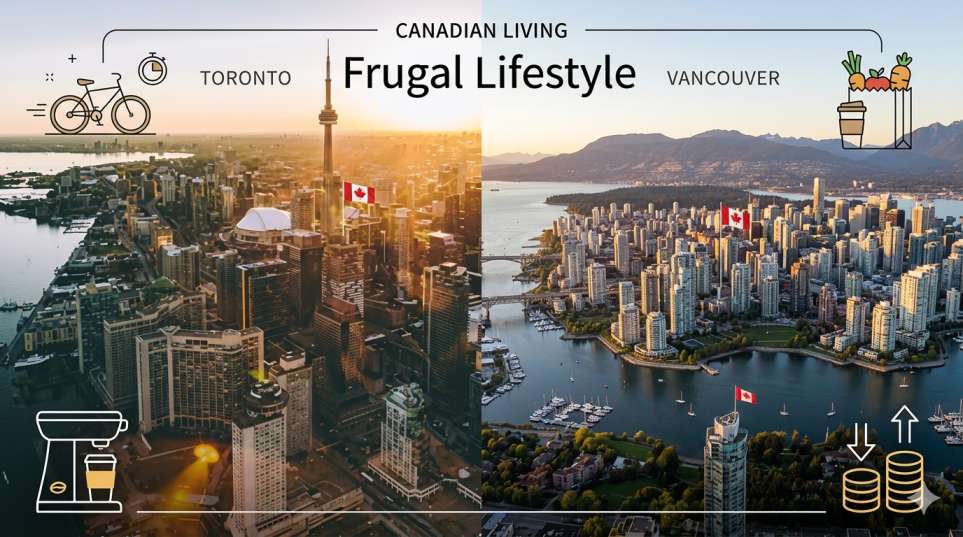
Let’s be honest: nobody moves to Toronto or Vancouver expecting it to be cheap. These two cities have cemented their reputation as among the most expensive places to live in North America, and 2026 hasn’t exactly made that easier. Food prices are projected to rise 4–6% this year alone. Rent for a one-bedroom in either city routinely clears $2,300 per month. And yet — millions of Canadians call these cities home and are quietly, cleverly making it work.
Here’s the thing nobody tells you: frugal living in Toronto and Vancouver isn’t about suffering through deprivation or fantasizing about moving to Saskatoon. It’s about making smarter micro-decisions across groceries, transit, housing arrangements, and entertainment that compound over time into real savings. Think $400, $600, even $900 a month — without uprooting your life.
This guide gives you a grounded, practical playbook for doing exactly that in 2026. Whether you’re a renter in East Vancouver trying to stretch a $55,000 salary or a downtown Toronto professional who can’t figure out where the money keeps going, these strategies are built for the reality of living in Canada’s two most expensive cities.
Why Toronto and Vancouver Are So Hard to Budget In (And Why You’re Not Imagining It)
Before we get into solutions, let’s look at the scale of the problem — because understanding the numbers helps you prioritize where to cut.
According to 2026 cost of living data, the average monthly cost of living for a single person in Vancouver is approximately $3,625 including rent, or about $1,575 without it. Toronto tracks similarly, with a single person typically needing $3,600 per month to cover all expenses. For families of four, those numbers jump to $6,200–$6,500 monthly.
Meanwhile, Statistics Canada data confirms that food prices are expected to climb 4–6% in 2026, adding nearly $1,000 per year to a typical family’s grocery bills. That’s on top of already elevated housing, telecom, and transportation costs.
The challenge isn’t just that costs are high — it’s that costs are high across every category simultaneously. There’s no easy relief valve. Which is exactly why a systematic, category-by-category approach is so much more effective than vague advice to “spend less.”
Comparison Table #1: Monthly Cost of Living — Toronto vs. Vancouver vs. Canadian Average (2026, Single Person)
| Expense Category | Toronto (Avg.) | Vancouver (Avg.) | Canadian City Avg. |
|---|---|---|---|
| Rent (1-BR, central) | $2,300 | $2,050 | $1,600 |
| Groceries | $450–$550 | $480–$580 | $400–$500 |
| Transit (monthly pass) | ~$156 | ~$145 | ~$110 |
| Utilities (electricity, heat) | $120–$180 | $90–$140 | $100–$150 |
| Internet | $70–$100 | $70–$100 | $65–$90 |
| Cell Phone | $55–$95 | $55–$95 | $55–$90 |
| Total (Estimated) | ~$3,300–$3,800 | ~$3,200–$3,700 | ~$2,500–$3,000 |
Sources: Statistics Canada, BearSavings Toronto vs Vancouver comparison, LivingCostIndex Vancouver 2026
The Big Three Cost Categories — And How to Tackle Each One
When you strip away everything else, housing, food, and transportation eat up the lion’s share of your budget in both cities. Let’s take each one seriously.
Housing — The Biggest Lever You Have
Housing is where the most dramatic savings are possible, and also where people feel the most stuck. But there are real options beyond “find a cheaper apartment.”
Room-sharing and co-living still makes the most sense financially. A private room in a shared house in East Toronto or East Vancouver typically runs $900–$1,300 per month — versus $2,300+ for a solo one-bedroom. That’s potentially $1,000+ saved every single month. If you’re single and under 35, this is the single highest-impact frugal decision you can make in either city.
Look beyond the obvious neighbourhoods. In Toronto, areas like Scarborough, North York, and parts of Etobicoke offer significantly lower rents than downtown or the Annex, while remaining well-connected by TTC. In Vancouver, East Vancouver, Burnaby, and New Westminster offer better value while sitting on SkyTrain lines. The commute might add 20–30 minutes, but if it saves you $400–$600 a month in rent, that’s worth doing the math on.
Negotiate your rent renewal. In a softening rental market (which Toronto has seen in late 2024 through 2025), landlords increasingly prefer keeping good tenants to re-listing. In Ontario, rent increase guidelines for 2025 were capped at 2.5%. If your landlord proposes more, know your rights under the Residential Tenancies Act — and don’t be afraid to push back.
Consider a basement suite. In Vancouver especially, basement suites in residential neighbourhoods can offer meaningful savings versus apartment-style units, often with quieter surroundings and even shared garden access.

Groceries — Where You Can Save $150–$300 Per Month Without Eating Worse
Food costs in Toronto and Vancouver run higher than most Canadian cities, but there is a clear, repeatable system for cutting your grocery bill significantly.
Master the discount grocery tier. Canada has a genuine discount grocery ecosystem that most people underuse. No Frills, FreshCo, Food Basics, and Walmart Grocery consistently price staples 20–35% below Loblaws or Safeway. In Vancouver, Save-On-Foods flyers and the No Name brand at Real Canadian Superstore can do similar work. Shopping here instead of premium stores is not a quality sacrifice — it’s a choice.
Use the Flipp app weekly, without fail. Flipp aggregates flyers from all major Canadian grocery chains and lets you build a shopping list around what’s on sale. Families who use it consistently report saving $50–$100 per grocery run. This is not couponing in the old labour-intensive sense — it takes about 10 minutes a week.
Buy proteins strategically. Meat and dairy are among the most expensive grocery categories in both cities. Buying in bulk at Costco (whole chicken, ground beef, pork shoulder), portioning at home, and freezing is one of the most effective frugal food strategies available. A $35 Costco rotisserie chicken can anchor four meals for two people.
Embrace ethnic grocery stores. Both Toronto and Vancouver have extraordinary networks of Asian, South Asian, Caribbean, and Middle Eastern grocery stores where produce, spices, legumes, and staples are priced 30–50% lower than mainstream chains. T&T Supermarket in Vancouver, and Hua Sheng or Sunny Foodmart in Toronto, aren’t just culturally rich options — they’re genuinely some of the best value grocery stores in their cities.
The meal prep multiplier. Cooking once and eating multiple times is the cheapest restaurant alternative. A $12 batch of red lentil soup yields 5 meals. A sheet pan of roasted vegetables costs $6 and covers lunch for a week. The math is overwhelming in favour of batch cookin

Transportation — Cutting Car Costs Could Save You $800+ Monthly
As one 2026 Canadian living costs breakdown notes, owning a car in Toronto or Vancouver — including insurance, gas, payments, and parking — can easily cost $1,370 or more per month. For frugal living in either city, the single most powerful transportation decision is going car-free or car-light.
Go car-free if you can. Toronto’s TTC and Vancouver’s TransLink are both functional, integrated systems. A monthly Presto card in Toronto runs about $156; a Compass Card monthly in Vancouver is around $145. That’s a fraction of what car ownership costs. If your work and social life are transit-accessible, going car-free is one of the highest-ROI frugal decisions in both cities.
Use car-share services for occasional needs. Modo in Vancouver and Communauto in Toronto offer hourly vehicle rentals that cover the occasional Costco run, camping trip, or IKEA haul — without the overhead of ownership. Budgeting $60–$80 a month for occasional car-share use, versus $1,000+ for car ownership, is a straightforward win.
Cycle year-round (seriously). Both cities have expanded cycling infrastructure meaningfully in the past five years. E-bikes have made year-round cycling accessible even in hilly Vancouver and snowy Toronto winters. A quality e-bike runs $800–$2,500 and pays for itself in months if it replaces a transit pass.
Bike-share as a transit supplement. Toronto’s Bike Share Toronto and Vancouver’s Mobi by Shaw Go offer affordable monthly passes ($15–$20) that efficiently cover the “last mile” problem between transit stops and your actual destination.
Lifestyle Spending — Where Hidden Costs Live (And How to Reclaim Them)
Big categories aside, lifestyle spending in expensive cities has a way of silently expanding to fill available income. Here’s where to look.
Telecom — Canada’s Most Overpriced Expense
Canada has some of the highest telecom costs in the developed world. A standard cell plan with 20–50GB of data from Bell, Rogers, or Telus runs $55–$95 per month. But the flanker brands — Koodo, Lucky Mobile, Public Mobile, and Freedom Mobile — offer functionally identical service at 30–50% lower prices. There’s no technical reason to pay more.
In 2026, Public Mobile’s $29 plan (15GB) and Freedom Mobile’s competitive 50GB options represent the best value in the market. Switching one phone plan can save $400–$600 per year with zero lifestyle impact.
For home internet, check whether TekSavvy, Distributel, or other independent ISPs service your building. They typically run $15–$25 less per month than Rogers or Bell for comparable speeds.
Entertainment — Free Toronto and Vancouver Are Surprisingly Rich
Both cities have an enormous amount of genuinely excellent free content if you know where to look.
Toronto’s public library system offers free museum passes to the ROM, Art Gallery of Ontario, and Aga Khan Museum — available to borrow with a library card. The Toronto Reference Library also has free access to Kanopy (streaming films and documentaries), LinkedIn Learning, and digital magazine archives.
Vancouver Public Library similarly offers free passes to the Vancouver Art Gallery, Museum of Vancouver, and H.R. MacMillan Space Centre. Both cities run extensive free summer festival calendars — Toronto’s TIFF free screenings, Nuit Blanche, outdoor concerts; Vancouver’s Celebration of Light, free Polygon Gallery admission on Tuesdays, Dr. Sun Yat-Sen Classical Chinese Garden Tuesday evening programs.
Replacing three $15 movie tickets and two restaurant meals per month with these free alternatives saves $100+ monthly with no reduction in social richness.
Dining Out — The $400-a-Month Trap
According to frugal living communities across Reddit Canada and Toronto Life reader surveys, unplanned dining out is consistently the category that surprises people most. Two people eating out in Toronto or Vancouver three times per week — including coffee — can easily spend $400–$600 monthly without realizing it.
The frugal approach isn’t to eliminate dining out, but to restructure it. Lunch specials at ethnic restaurants (often $10–$14 for a full meal in both cities) versus dinner service (same dish: $18–$26) is one of the simplest arbitrages. Food trucks, night markets in Vancouver’s Richmond, and Kensington Market in Toronto offer restaurant-quality food at significantly lower prices.
Setting a firm dining budget — say, $150–$200/month for a single person — and tracking it with a free app like YNAB or Monarch Money turns this from a vague intention into a practical system.

The 2026 Frugal Living Toolkit — Apps and Resources That Actually Help
Frugal living in 2026 is also a technology problem. The right tools make the system automatic.
Budgeting: YNAB ($14.99/month but saves most users far more), Monarch Money, or the free Wealthsimple app all give you real-time visibility into where money is going. You cannot manage what you don’t measure.
Grocery savings: Flipp (flyer aggregation), PC Optimum (Loblaws loyalty points — genuinely valuable if you shop there), and the Checkout 51 cashback app all return real money with minimal effort.
Housing search: Rentals.ca, PadMapper, and Facebook Marketplace (for private landlord listings with lower fees) give you better market visibility than relying on any single source.
Side income: Both cities have robust gig economies. TaskRabbit, Rover (pet sitting), Fiverr, and local Facebook groups for freelance services give Torontonians and Vancouverites ways to add $200–$600 monthly in flexible income that directly offsets core costs.
A Realistic Monthly Budget — What Frugal Living Actually Looks Like in 2026
Let’s put this all together with a concrete scenario.
Case Study: Alex, Single Professional, Living in East Vancouver / East Toronto
Alex earns $62,000 per year ($4,350/month after taxes). Here’s how a frugal-but-livable budget looks with the strategies in this guide applied:
Comparison Table #2: Standard Budget vs. Frugal Budget (Single Person, Toronto or Vancouver, 2026)
| Category | Standard Monthly Spend | Frugal Monthly Spend | Monthly Savings |
|---|---|---|---|
| Rent (solo 1-BR vs. shared room) | $2,300 | $1,100 | $1,200 |
| Groceries | $550 | $300 | $250 |
| Transit (TTC/TransLink pass) | $156 | $145 | $11 |
| Car (ownership costs) | $1,000 | $0 (car-free + Modo) | $1,000 |
| Cell phone | $85 | $35 (flanker brand) | $50 |
| Internet | $95 | $70 (indie ISP) | $25 |
| Dining out | $450 | $150 | $300 |
| Entertainment | $120 | $30 | $90 |
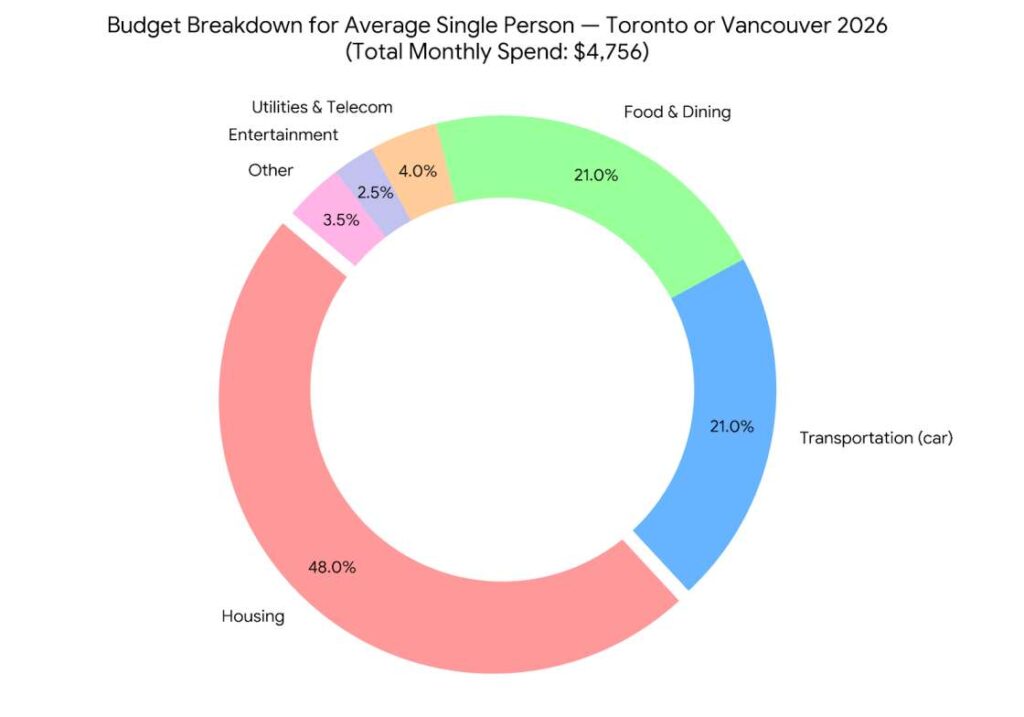
| Monthly Total | ~$4,756 | ~$1,830 | ~$2,926 |
Note: Car-free scenario assumes living along a transit corridor. Rent savings assume room in a shared home vs. solo 1-BR. All figures approximate for 2026.
The takeaway: A fully applied frugal strategy in Toronto or Vancouver doesn’t just save a few dollars — it can genuinely transform the financial picture, creating room for savings, TFSA contributions, and stress reduction, without requiring a move.
Neighbourhood-Specific Tips — Where to Live for Best Value in Each City
Best Value Neighbourhoods in Toronto (2026)
Scarborough (near Scarborough Town Centre or Kennedy Station): Rents average $300–$500/month lower than downtown for comparable units. Well-served by TTC. Diverse food options with some of the city’s best and most affordable restaurants.
North York (near Finch or Sheppard): Consistent value play with solid transit access. Closer to Toronto’s tech and business corridors than its reputation suggests.
Weston / Mount Dennis: Up-and-coming area now on the Eglinton Crosstown LRT line (opening 2024–2025). Lower rents, improving transit access, multicultural food scene.
Best Value Neighbourhoods in Vancouver (2026)
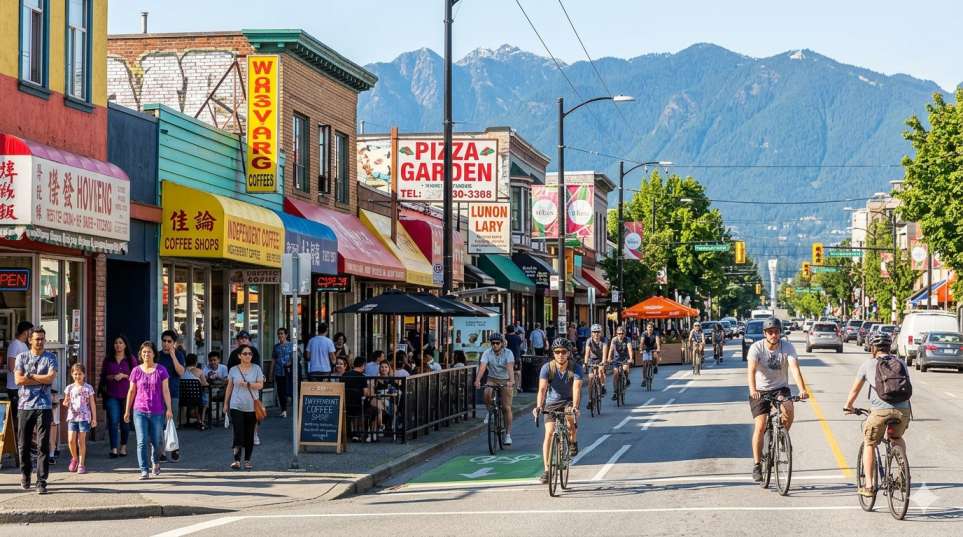
East Vancouver (Commercial Drive to Renfrew): The classic frugal choice. Strong community culture, excellent food scene, on multiple bus and SkyTrain corridors. Rents run $200–$400 lower than West Side.
Burnaby (Metrotown area): Often overlooked but sits on the Expo Line SkyTrain, has Metropolis at Metrotown for cheap food court options, and rents meaningfully below Vancouver’s West Side.
New Westminster: One of the best-value SkyTrain-accessible areas in Metro Vancouver. Smaller city feel, strong community, genuinely lower rents — often $400–$600 below equivalent units in Vancouver proper.
What About Earning More? The Other Side of the Frugal Equation
Frugal living in expensive cities works best when paired with intentional income growth. Both Toronto and Vancouver have robust labour markets in tech, healthcare, trades, and finance. In 2026, remote and hybrid work arrangements also continue to expand the possibilities for Canadians in either city.
Three high-impact moves worth considering alongside your frugal strategy: negotiating your current salary (the average Canadian leaves 10–20% on the table at job offer stage), upskilling through free or low-cost platforms (Coursera, edX, LinkedIn Learning via your public library), and adding a modest side income through freelance work that uses existing skills.
You don’t need to hustle yourself to exhaustion. But adding even $300–$500 per month in supplementary income, combined with the savings strategies above, can dramatically accelerate your financial trajectory while staying in the city you’ve chosen to call home.
Infographic Opportunity
Suggested Infographic: “The Frugal Living Matrix — Toronto & Vancouver Edition”
A visually designed one-page graphic showing:
- 5 spending categories (Housing, Food, Transport, Telecom, Entertainment)
- For each: Average spend vs. Frugal spend, with the % savings illustrated
- Bottom summary: Total monthly savings ($1,500–$2,900) and annual impact
- Design direction: Clean, bold typography, Canadian colour palette (red/white/navy), icons for each category
This would be a strong Pinterest/Instagram pin and highly shareable for FrugalLiving.ca’s social presence.
Conclusion: You Can Make It Work — And Stay
Moving to Calgary or Moncton to save money is a legitimate choice for some Canadians. But it’s far from the only one. The most effective approach to frugal living in Toronto or Vancouver is a methodical one — tackling housing first (your biggest lever), then groceries and transportation, then the smaller categories that add up surprisingly fast.
To summarize the key takeaways from this guide: room-sharing or choosing lower-cost transit-accessible neighbourhoods can save $800–$1,200 monthly on housing alone. Switching to discount grocers, using weekly flyers, and batch cooking can cut your food bill by $150–$300. Going car-free or car-light saves $500–$1,000. Switching to flanker telecom brands saves $50–$60 per month with zero sacrifice. And replacing paid entertainment with the genuinely rich free cultural options both cities offer costs nothing at all.
Applied together, these strategies make $2,500+ in monthly savings achievable for a single person — without packing a single box.
Toronto and Vancouver are expensive. They’re also where your job, your network, your family, and your community might be. Frugality, done right, is how you stay.
