


Every year, hundreds of thousands of Ontario residents miss out on hundreds — sometimes thousands — of dollars in government money. Not because they aren’t eligible. Not because the program doesn’t exist. Simply because they don’t know about it, don’t understand how it works, or make small filing mistakes that cost them big.
That program is the Ontario Trillium Benefit (OTB), and if you live in Ontario and haven’t looked into it lately, there’s a real chance you’re not getting everything you’re owed.
The OTB is a combined, tax-free monthly payment from the provincial government — administered by the Canada Revenue Agency (CRA) — that bundles three separate credits into one convenient deposit. It’s designed to help low- and moderate-income Ontarians cover the rising costs of energy, property taxes, and everyday spending. For eligible households, this can add up to over $3,200 a year, landing in your bank account on the 10th of every month.
In this guide, we’re going to break down exactly what the Ontario Trillium Benefit is, who qualifies, how much you can realistically expect, and — most importantly — the concrete steps you can take right now to make sure you’re maximizing every dollar. Whether you’re a renter in Toronto, a homeowner in Hamilton, or a senior in Sudbury, this article has something for you.
What Is the Ontario Trillium Benefit? A Plain-Language Breakdown
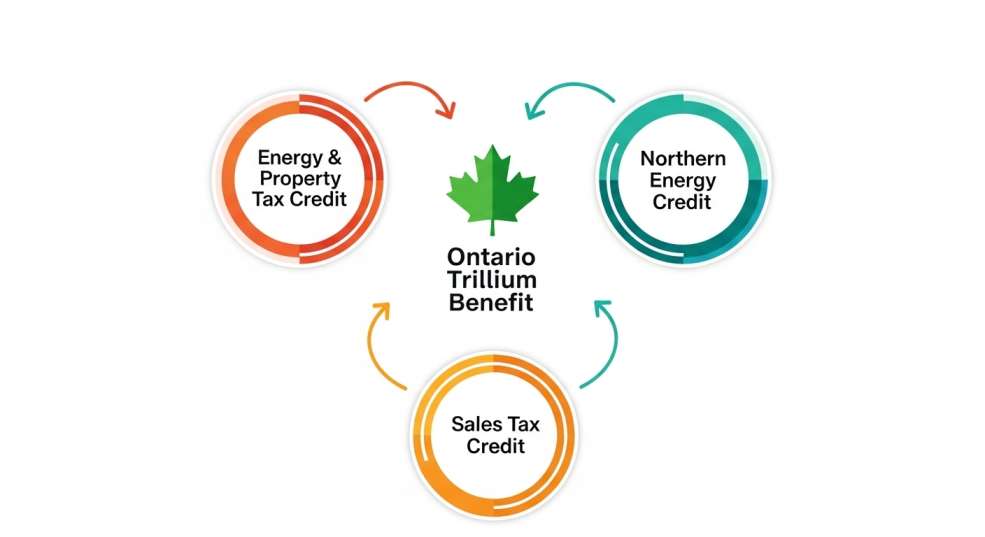
The Ontario Trillium Benefit isn’t a single credit — it’s actually three provincial credits rolled into one payment. Think of it as a bundle deal from the Ontario government, delivered monthly to help offset essential living costs.
The OTB combines three distinct Ontario tax credits: the Ontario Energy and Property Tax Credit (OEPTC), the Northern Ontario Energy Credit (NOEC), and the Ontario Sales Tax Credit (OSTC). Rather than issuing three separate credits, the province bundles them into a single monthly payment, simplifying the process for recipients.
Here’s what each component covers:
1. Ontario Energy and Property Tax Credit (OEPTC) This is the largest component for most recipients. It helps homeowners and renters offset the costs of property taxes and the sales tax paid on energy. For the 2025–2026 benefit year, non-seniors can receive up to $1,283, while those aged 64 and older can receive a maximum of $1,461.
2. Northern Ontario Energy Credit (NOEC) This component is exclusive to residents of Northern Ontario, acknowledging that heating costs in communities like Thunder Bay, Sudbury, and Kenora are significantly higher than in the south. If you’re single, you could receive a maximum of $185. Families could receive a maximum of $285.
3. Ontario Sales Tax Credit (OSTC) This credit helps offset the HST that lower-income Ontarians pay on everyday purchases. For payments based on your 2024 income tax and benefit return (July 2025 to June 2026), the program provides a maximum annual credit of $371 for each adult and each child in a family.
Together, these three components can provide substantial monthly relief — and the best part is that you don’t need to apply separately for any of them.
Who Qualifies for the Ontario Trillium Benefit?
Eligibility for the OTB is assessed automatically when you file your annual income tax return — there’s no separate application needed. However, understanding the criteria can help you confirm you’re not inadvertently being left out.
General Eligibility Requirements
To qualify for the Ontario Trillium Benefit, you must:
- Be a resident of Ontario as of December 31 of the tax year
- Be at least 19 years old, OR be (or have been) married or in a common-law relationship, OR be (or have been) a parent living with your child
- File your annual income tax and benefit return with the CRA
- Complete Form ON-BEN (Application for the Ontario Trillium Benefit and Ontario Senior Homeowners’ Property Tax Grant)
Eligibility by Component
Each credit within the OTB has its own specific conditions:
For the OEPTC, you must have paid rent or property tax for your principal residence in Ontario, lived in a public long-term care home, lived on a reserve and paid home energy costs, or been a student in university or college residence. Your landlord must have been required to pay municipal or education property tax on your unit — something renters in subsidized housing should verify with their building manager.
For the NOEC, you must have lived in a Northern Ontario district — which includes Algoma, Cochrane, Kenora, Manitoulin, Nipissing, Parry Sound, Rainy River, Sudbury (including Greater Sudbury), Thunder Bay, and Timiskaming — on December 31 of the tax year.
For the OSTC, you simply need to be an Ontario resident with income below the phase-out thresholds. No additional housing costs need to be reported.
Are Newcomers and Temporary Residents Eligible?
This is a question that comes up often. Temporary residents (e.g., on work or study permits) may qualify if they’re Ontario residents for tax purposes and meet credit-specific requirements. This means that if you hold a valid Social Insurance Number (SIN), file a Canadian tax return, and genuinely live in Ontario, you may be entitled to OTB payments even if you’re not a permanent resident or citizen.
How Much Can You Actually Receive? (2025–2026 Figures)
This is where the Ontario Trillium Benefit starts to get really interesting. The amounts aren’t fixed — they depend on your income, household size, housing costs, and where you live in Ontario. But the potential totals are significant.
For eligible Ontario families, the combined OTB payment can provide up to $3,230 annually, depending on income, household composition, and whether you live in Northern Ontario.
TABLE 1: Maximum Ontario Trillium Benefit Amounts by Component (2025–2026 Benefit Year)
| OTB Component | Who It Applies To | Max Annual Amount |
|---|---|---|
| Ontario Energy & Property Tax Credit (OEPTC) — Non-Senior | Renters/homeowners under 64 in Ontario | Up to $1,283 |
| Ontario Energy & Property Tax Credit (OEPTC) — Senior | Residents 64+ in Ontario | Up to $1,461 |
| Northern Ontario Energy Credit (NOEC) — Single | Single residents of Northern Ontario | Up to $185 |
| Northern Ontario Energy Credit (NOEC) — Family | Families in Northern Ontario | Up to $285 |
| Ontario Sales Tax Credit (OSTC) — Per Adult | All eligible Ontario adults | $371 per adult |
| Ontario Sales Tax Credit (OSTC) — Per Child | Dependent children under 19 | $371 per child |
Source: Canada Revenue Agency / Ontario.ca (2025–2026 figures)
TABLE 2: Income Phase-Out Thresholds — When Does the OTB Start to Reduce?
| Credit Component | Phase-Out Starts (Single) | Phase-Out Starts (Families) |
|---|---|---|
| Ontario Sales Tax Credit (OSTC) | ~$30,159 adjusted net income | ~$37,699 adjusted family net income |
| Ontario Energy & Property Tax Credit (OEPTC) | ~$58,238 adjusted net income | ~$72,798 adjusted family net income |
| Northern Ontario Energy Credit (NOEC) | ~$58,238 adjusted net income | ~$72,798 adjusted family net income |
Source: Canada Revenue Agency (approximate 2025 thresholds — confirm at canada.ca)
The OSTC phases out at a much lower income than the OEPTC or NOEC. That means even middle-income Ontarians — especially homeowners or renters with significant property and energy costs — can still qualify for a meaningful OEPTC payment well above the $30,000 threshold.
KEY TAKEAWAY
How and When Are OTB Payments Made?
Understanding the payment schedule is practical — and can help you plan around it.
The Ontario Trillium Benefit follows a consistent payment schedule, with deposits issued on the 10th of each month. When the 10th falls on a weekend or statutory holiday, the payment is issued on the last business day before the scheduled date.
The OTB benefit year runs from July to June, not from January to December. This means payments issued from July 2025 through June 2026 are calculated based on your 2024 income tax return, while payments from July 2026 through June 2027 will be based on your 2025 tax return.
There’s one important distinction to be aware of regarding payment amounts. If your total annual OTB entitlement is $360 or less, you will receive your entire benefit as a single lump-sum payment in July rather than monthly installments. Those entitled to more than $360 will receive their benefit divided into 12 equal monthly payments.
You also have the option to choose a single annual payment even if your entitlement exceeds $360 — some people prefer receiving a larger sum at once rather than smaller monthly amounts. Select this option by ticking box 61060 on Form ON-BEN when filing your tax return.
Setting up direct deposit is strongly recommended. If you receive your income tax refund by direct deposit, you’ll automatically receive OTB payments to your bank account — the fastest and most secure method.
How to Apply: It’s Simpler Than You Think
One of the best things about the Ontario Trillium Benefit is that there’s no standalone application. To calculate how much you could get overall from the Ontario Trillium Benefit, use the CRA child and family benefits calculator.
The process works like this:
Step 1: File your annual income tax return. You must file even if you have no income or minimal income. Students, seniors on fixed incomes, and low-income earners are all required to file to access OTB benefits. You can still qualify for the Ontario Trillium Benefit even if you’re a student or have no income. The key requirement is filing your personal income tax return, even when you have nothing to report.
Step 2: Complete Form ON-BEN. This form is included with your T1 General return and is where you report your rent paid, property taxes paid, and housing information. Without this form completed, the CRA cannot calculate your OEPTC or NOEC. This is a commonly missed step.
Step 3: Keep your CRA information current. Update your address, banking details, and marital status through your CRA My Account portal. Outdated information is one of the most common reasons people miss or receive incorrect OTB payments.
Step 4: Wait for your first payment. The Canada Revenue Agency will review your tax return and determine if you’re eligible for the three credits. If approved, payments begin in July.
7 Proven Strategies to Maximize Your Ontario Trillium Benefit
Here’s where we get into the real value — the actionable strategies that make a genuine difference in how much you receive.
1. File Your Taxes Every Year — Even With Zero Income
This cannot be overstated. If you don’t file, you don’t get paid. Late filing may delay your payments. Returns assessed after the June 19 deadline may result in your first payment being delayed by 4–8 weeks. File before April 30 every year.
2. Report Every Dollar of Eligible Housing Costs on Form ON-BEN
Many renters underreport their housing expenses simply because they’re unsure what counts. Eligible costs include rent paid to a landlord who pays property tax, annual property tax amounts (for homeowners), and in some cases, accommodation costs paid in long-term care. Keep your lease agreements and rent receipts. Your annual rent total makes a direct difference to your OEPTC amount.
3. Claim the Right Occupancy Type
Whether you’re a renter, homeowner, student in residence, reserve resident, or long-term care resident — these statuses are each treated differently on Form ON-BEN. Selecting the wrong occupancy type is a surprisingly common error that can significantly reduce your credit.
4. Don’t Forget About the OSTC for Your Dependents
The Ontario Sales Tax Credit provides a maximum annual credit of $371 for each adult and each child in a family. If you have three kids and a spouse, that’s potentially $1,855 in OSTC alone. Every eligible dependent should be claimed.
5. Sign Up for CRA Direct Deposit and My Account
Direct deposit gets you paid faster and reduces the risk of cheques going to a wrong address. The CRA’s My Account portal also lets you track payment status, update details, and view your benefit history. Use CRA My Account to track payment statuses, update details, or address any issues.
6. Take Advantage of Free Tax Filing Clinics
If cost is a barrier to filing, the CRA’s Community Volunteer Income Tax Program (CVITP) offers free tax filing assistance to eligible low-income Canadians. This program is available in-person and virtually across Ontario. A free clinic could unlock hundreds of dollars a month in OTB payments.
7. Check Your Eligibility Again After a Life Change
Major life events — moving, separation, a new child, a job loss, a new roommate situation — can all change your OTB entitlement. If your income dropped, your family grew, or you moved to Northern Ontario, you may be eligible for significantly more than you were receiving previously. Review your eligibility every tax season, not just once.

Real-World Scenarios: What Might You Actually Receive?
Let’s ground this in reality with a few example situations.
Scenario 1: Maria, 28, renting in Toronto, income $32,000 Maria rents a basement apartment for $1,200/month, paying $14,400 in rent annually. She doesn’t own a car or property. Her income is just above the OSTC phase-out threshold, so she receives a reduced OSTC. However, her OEPTC is substantial because of her rent amount. She might receive around $900–$1,100/year — roughly $90/month landing in her account on the 10th.
Scenario 2: David and Susan, married homeowners in London, combined income $55,000, two children This family pays $4,500/year in property taxes. They’re below the OEPTC phase-out threshold and qualify for the full OSTC for all four family members ($1,484). Combined with their OEPTC, they could receive $2,200–$2,600 annually — approximately $190/month.
Scenario 3: Robert, 67, renting in Sudbury (Northern Ontario), income $22,000 As a senior in Northern Ontario, Robert qualifies for the senior-enhanced OEPTC, the NOEC, and the OSTC. With low income and senior status, he may receive close to the maximum in all three components — potentially $2,000+ per year, or over $165/month.
These scenarios illustrate how powerful the OTB can be for different Canadians — and why understanding your situation is worth the effort.
Common Mistakes That Reduce or Eliminate Your OTB Payments
Knowing what not to do is just as important as knowing what to do.
Not filing Form ON-BEN: Many people file their T1 return but forget to complete the ON-BEN section within it. Without this form, the CRA cannot calculate your OEPTC or NOEC — you’ll only receive the OSTC, if eligible.
Forgetting to update your address: If you move and don’t update your address with the CRA before the 10th of a payment month, your cheque may be returned undeliverable and your payment will be delayed.
Underreporting rent: Some renters, particularly those paying cash or renting informally, don’t include their rent on their tax return. This is a significant missed opportunity.
Missing the tax deadline: If your return is assessed after June 19, your first payment may be delayed by 4–8 weeks. File by April 30 to ensure no gaps in your payment schedule.
Assuming you don’t qualify: A surprising number of people assume the OTB is only for people living in poverty. In reality, middle-income Ontarians with high property taxes or rent can still receive meaningful OEPTC payments even if they’ve phased out of the OSTC.
The OTB and Other Benefits: How They Stack Up
The Ontario Trillium Benefit doesn’t exist in isolation — it’s part of a broader ecosystem of federal and provincial support programs that can significantly boost a household’s annual income.
If you qualify for the OTB, you may also be eligible for the Canada Child Benefit (CCB), the GST/HST Credit, the Ontario Senior Homeowners’ Property Tax Grant, and potentially the Canada Workers Benefit. These programs are all accessed through your annual tax return and, taken together, represent a powerful financial safety net for low- and moderate-income Ontarians.
The OTB is notable because, unlike some benefits that require separate applications and documentation, it’s entirely automated through your tax return. This makes it uniquely accessible — but also uniquely easy to miss if you don’t file.
Frequently Asked Questions About the Ontario Trillium Benefit
Do I need to reapply for the OTB every year? No. You apply through your annual tax return by completing Form ON-BEN each year. There’s no standalone renewal process.
What if I receive the OTB in error — do I have to pay it back? Yes. If the CRA determines you were overpaid, they will issue a notice and recover the funds, usually by reducing future payments. Always ensure your information is accurate when filing.
I moved from Northern Ontario to Southern Ontario mid-year. Do I still get the NOEC? Your eligibility depends on where you live on the first day of each payment month. If you move out of Northern Ontario mid-month, you would be eligible for that month’s NOEC payment, but you wouldn’t be eligible for any subsequent payment.
Can I get the OTB if I live in subsidized housing? It depends. If you lived in a subsidized housing unit, check with your landlord to find out if they were required to pay property tax for your unit. If they were, you can claim your rent. If not, you may not be eligible for the OEPTC, though you may still qualify for the OSTC.
My child just turned 18. Can they apply? If you turn 18 before June, you should apply and file your tax return to be considered for the Ontario Trillium Benefit. Young adults who file their own returns and live independently can access the OTB in their own right.
Where can I check the status of my OTB payment? Log in to your CRA My Account at canada.ca/my-cra-account to view your benefit status, payment history, and upcoming amounts.

Conclusion: Don’t Leave Your OTB Money on the Table
The Ontario Trillium Benefit is one of the most accessible, impactful, and — strangely — underutilized financial programs available to Ontarians today. It doesn’t require a lengthy application process, a financial advisor, or insider knowledge. It just requires you to file your taxes, fill in Form ON-BEN accurately, and keep your information up to date with the CRA.
For many families, the OTB represents hundreds to thousands of dollars annually — real money that can cover a utility bill, a grocery run, or go straight into a savings account. For seniors and low-income residents in Northern Ontario, it can be even more.
Here’s the quick summary of what we covered:
The OTB combines three Ontario tax credits — OEPTC, NOEC, and OSTC — into one tax-free monthly payment. Eligible families can receive up to $3,230 per year. You don’t need to apply separately; your annual tax return handles it. Completing Form ON-BEN and reporting accurate housing costs is critical. Filing on time, setting up direct deposit, and maintaining current CRA records are the top strategies for maximizing your benefit.
At FrugalLiving.ca, we believe that knowing your benefits is the first step to keeping more of your own money. The Ontario Trillium Benefit is one of those programs where a small investment of time — completing your return properly — pays off with consistent, tax-free cash flow throughout the year.
If you found this guide helpful, consider sharing it with someone in Ontario who might be missing out. And if you have questions about your specific situation, the CRA’s benefits calculator at canada.ca and free Community Volunteer Income Tax clinics are both excellent, no-cost resources.
This article is for informational purposes only and reflects program details as of early 2026. Benefit amounts, thresholds, and eligibility criteria are reviewed annually. Always verify current figures at canada.ca or by contacting the CRA directly at 1-800-959-8281.
About FrugalLiving.ca: Canada’s go-to resource for practical money-saving strategies, government benefits, and financial tips tailored for everyday Canadians.
