

Every year, millions of Canadians sign new leases without ever asking one of the most financially important questions they could: Is now actually a good time to move?
The answer matters — a lot. Depending on what month you sign your lease, you could be paying hundreds of dollars more per month than your neighbour in the same building who had the foresight to move during the rental market’s off-season. Over the course of a year, that adds up to thousands of dollars you could have kept in your pocket.
This isn’t a secret known only to real estate insiders. It’s a well-documented seasonal pattern that affects rental markets from Victoria to Halifax. And yet, most renters move when it’s convenient — typically in summer — which is precisely when landlords have the most leverage and rents are at their peak.
In this guide, we break down the best time of year to move in Canada to get the cheapest rent, season by season and city by city. We also cover how to maximize your negotiating power, when moving company costs are lowest, and how to time the whole process for maximum savings.
The cheapest time to rent in Canada is between November and February, with January being the sweet spot in most major cities. Demand drops sharply, landlords are more flexible, and moving company rates are 30–40% lower than summer peaks.
💡 Quick Answer
How Canadian Rental Markets Work Seasonally
To understand when to move, you first need to understand why rent prices fluctuate throughout the year. It all comes down to supply and demand — but the demand side of that equation is heavily influenced by some very Canadian factors.
The Forces That Drive Seasonal Rental Demand
Canadian rental markets follow a fairly predictable annual rhythm, driven by:
- University and college academic calendars (September intake and April/May lease-ends create massive student-driven demand)
- Corporate relocation cycles (Q1 and Q3 are peak hiring seasons, prompting job-related moves)
- Family school year constraints (families prefer to move in summer to avoid disrupting school)
- Immigration patterns (new arrivals tend to concentrate in warmer months when settling is easier)
- Weather (yes, Canadians are less likely to sign leases and physically move in -20°C winters)
The result? A rental market that’s brutally competitive from May through August, moderately active in spring and fall, and quietly advantageous for renters from November through February.
According to data from Rentals.ca and Zumper’s Canadian Rent Report, national one-bedroom rents saw their sharpest year-over-year drops in November 2025, when prices fell approximately 5% — a clear signal of the off-season effect at work. Meanwhile, summer months have historically been when rents peak and competition is fiercest.
TABLE 1: Canadian Seasonal Rental Market Overview
A snapshot of how each season affects rental demand, pricing, and your negotiating power as a renter.
Season | Months | Demand Level | Rent Prices | Negotiating Power |
❄️ Winter | Nov – Feb | 🔴 Very Low | ✅ Lowest | ⭐⭐⭐⭐⭐ |
🌸 Spring | Mar – May | 🟡 Moderate | ⚠️ Rising | ⭐⭐⭐ |
☀️ Summer | Jun – Aug | 🔴 Very High | ❌ Highest | ⭐ |
🍂 Fall | Sep – Oct | 🟡 Moderate | ⚠️ Stable | ⭐⭐⭐ |
The Best Time of Year to Move in Canada: Season by Season
Winter (November – February): The Clear Winner for Cheap Rent
If saving money is your primary goal, winter is your season. This is universally the best time to move in Canada if you want cheap rent, and the data backs it up clearly.
Fewer people are interested in moving when it’s cold — the weather is harsh, schools are in session, and the holidays disrupt everyone’s planning. As demand for apartments drops sharply, landlords who need to fill vacancies become noticeably more flexible. You’ll see lower asking prices, more willingness to negotiate, and in many cases, move-in incentives like a free first month’s rent or waived application fees.
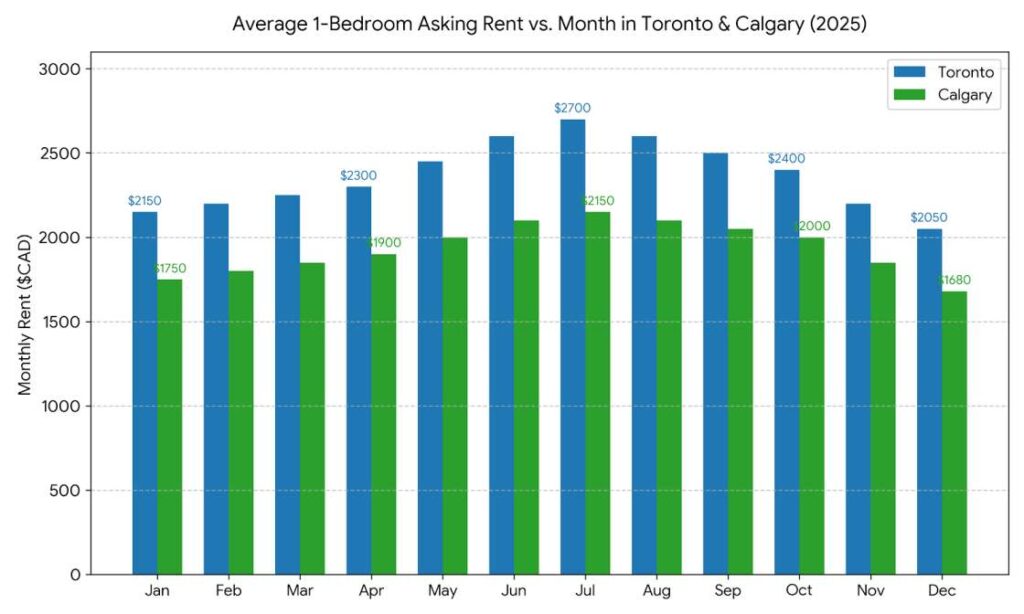
According to apartment industry research, the national median rent typically falls by around 1.6% from its summer peak to its lowest point in November — and in some Canadian markets, that discount is even greater. On a $2,200/month Toronto apartment, 1.6% sounds modest, but when landlords are also open to negotiating first/last month terms and skipping credit check fees, the total savings can be significantly higher.
Winter also dramatically reduces your moving costs. Moving companies experience up to a 60% drop in volume during cold months, and many offer discounts ranging from 10% to 40% off summer rates. (Source: Professional Movers Ottawa) If a summer move costs $3,500, the same move in January might run $2,100 to $2,450 — a saving of $1,000 to $1,400 before you’ve even started negotiating rent.
January is often the single best month to sign a lease in Canada. The holiday rush is over, landlords are staring at vacant units in the new year, and you have significant negotiating power. Start your search in mid-to-late November for a January 1 or February 1 move-in date.
💡 PRO TIP
Spring (March – May): Good Selection, Rising Prices
Spring is a reasonable second choice if winter doesn’t work for your schedule. March through May offers a growing inventory of available units as the market starts to wake up — but prices are on the rise as demand picks up.
The advantage of spring is selection. More landlords list units in anticipation of the summer rush, giving renters more options to compare. You can still negotiate in March and early April before competition becomes fierce. By May, however, you’re entering peak territory and your leverage starts to shrink.
Spring is a good time to move if you have children in school and need to relocate before the summer break, or if you’re starting a new job in April or May. Just be prepared that rents will be higher than winter and competition will be increasing week by week.
Summer (June – August): The Most Expensive Time to Move in Canada
Summer is peak rental season — full stop. This is when demand is highest, inventory moves fastest, and landlords have the most power. University students are hunting for September-start apartments. Families are relocating before the school year. New immigrants are arriving. Corporate transfers are happening.
The practical result: landlords rarely negotiate, multiple people are applying for the same unit simultaneously, and rents sit at or near their annual highs. Moving company rates are also at their peak, with the busiest firms booked 4 to 8 weeks in advance.
If you must move in summer, try to target mid-June or late August, when the two main waves of student demand (early June leavers and August pre-September arrivals) have slightly subsided. Moving mid-month rather than at month-end can also reduce moving company costs, as end-of-month dates are the most in-demand.
Fall (September – October): The Underrated Window
Fall is an often-overlooked sweet spot. After the August surge subsides, the market cools noticeably in September and October. Prices stabilize, the frenzy dies down, and renters have a bit more breathing room. It’s not as advantageous as winter, but it’s a far more balanced market than summer.
September can be tricky near universities — student demand peaks early in the month as classes begin. But by late September and into October, conditions improve meaningfully. If you’re flexible on timing and can’t manage a winter move, targeting October is a smart compromise: decent selection, stabilizing prices, and landlords more willing to entertain offers.
Best Month to Move by Canadian City
While winter is generally the best time to move anywhere in Canada, the optimal timing varies slightly by city based on local job markets, university calendars, and immigration patterns. Here’s a city-by-city breakdown to help you plan precisely.
TABLE 2: Best Month to Move for Cheap Rent — By Canadian City
Estimated savings compared to summer peak rates. Figures based on seasonal demand data and industry reporting.
City | Best Month to Move | Why It’s Cheap | Est. Savings vs. Peak |
Toronto, ON | Jan – Feb | Post-holiday low demand; student cycle pauses | 5–8% |
Vancouver, BC | Jan – Feb | Fewest listings but lowest competition; rain season | 4–7% |
Calgary, AB | Nov – Feb | Slowest corporate relocation period; harsh winters deter movers | 6–10% |
Montreal, QC | Dec – Jan | Students home for holidays; long-term leases reset in Feb | 5–9% |
Ottawa, ON | Nov – Jan | Government hiring lulls; fewer students competing | 4–7% |
Edmonton, AB | Dec – Feb | Oil sector quiets; coldest months see fewest new arrivals | 5–8% |
Winnipeg, MB | Nov – Feb | Severe winter deters renters; landlords eager to fill units | 7–12% |
Halifax, NS | Jan – Feb | Post-holiday quiet; university semester not yet in swing | 4–6% |
Sources: Zumper Canadian Rent Report (March 2026), Rentals.ca National Rent Report, CMHC Housing Market Outlook.

The Double Win: Lower Rent AND Cheaper Moving Costs in Winter
Here’s something most guides on this topic miss entirely: when you move in winter, you don’t just save on rent — you also save significantly on the cost of the move itself.
Moving companies across Canada reduce their rates substantially during the off-season. With the number of moves dropping by nearly 60% during cold months, companies need to fill their schedules and often discount aggressively. Industry sources report savings of 10–40% off summer rates, and in some markets, even more during the post-holiday January lull.
Add that to rent savings, and the financial case for a winter move becomes even more compelling. Let’s look at a real-world scenario:
📖 Real-World Example: Scenario: Sarah is moving from a Toronto bachelor to a 1-bedroom in the same city. In July, her new rent is $2,400/month and her movers charge $3,200. In January, the same apartment might list at $2,200/month and movers might charge $2,100 — saving her $200/month on rent plus $1,100 on the move. Over 12 months, that’s $3,500 in total savings just from timing her move. |
TABLE 3: Summer vs. Winter Moving Costs — What Canadians Actually Pay
Estimated ranges based on national averages for a local move within a Canadian city. Costs vary by province and distance.
Cost Category | Summer (Peak) | Winter (Off-Peak) | Potential Savings |
Moving Company (local) | $1,500–$3,500 | $900–$2,100 | Up to 40% |
Monthly Rent (1-bed, avg.) | $2,000–$2,800 | $1,800–$2,500 | 5–10% |
Truck Rental | $150–$400/day | $80–$200/day | 30–50% |
First/Last Month Deposit | At market rate | Negotiable | Varies |
Application Competition | High – fewer deals | Low – more leverage | N/A |
Mover Availability | Book 4–8 weeks out | Book 1–2 weeks out | Flexibility |
How to Negotiate Rent During the Off-Season
Getting a cheap rent isn’t just about showing up in January. It’s about knowing how to use the market conditions in your favour. Here’s how to approach negotiations when you have the leverage:
Do Your Research First
Before you make an offer or counteroffer, check what similar units in the same neighbourhood are asking right now. Sites like Rentals.ca, Zumper, and Padmapper let you filter by date listed, so you can see if a unit has been sitting vacant for weeks. Vacancy = landlord motivation.
Lead With Your Strengths as a Tenant
In a slow market, landlords aren’t just looking for the highest rent — they want a reliable tenant. Come prepared with proof of employment or income, a credit score printout, and references from previous landlords. Position yourself as the low-risk, hassle-free choice, and you gain leverage beyond just price.
Ask for Incentives, Not Just Lower Rent
Sometimes landlords are reluctant to reduce the official asking price (especially in rent-controlled provinces like Ontario and BC, where the listed rate anchors future increases). Instead, ask for: a free first month’s rent, waived parking fees, reduced last month’s deposit, or a longer rent-free period before your lease starts. These concessions can be worth hundreds or even thousands of dollars without changing the stated rent.
Offer Stability in Exchange for a Discount
If you’re willing to sign a 2-year lease instead of 1 year, or agree to move in on a specific date that works well for the landlord, use that as a bargaining chip. Landlords value certainty, and a committed long-term tenant is often worth a 5–10% discount over a month-to-month uncertainty.

Is the 2025–2026 Market Different? What to Know Right Now
Canada’s rental market has been cooling from its post-pandemic highs, and for renters, that’s actually good news on top of the seasonal advantage you’d already have in winter.
National asking rents declined by approximately 1.5% year-over-year in mid-2025, according to CMHC and industry tracking from Rentals.ca. The national vacancy rate reached 4.1% in Q2 2025 — the highest point in five years — giving renters more options and more power than they’ve had in years.
Cities like Toronto and Vancouver, which saw astronomical rent increases in 2022–2023, have both experienced notable declines. Vancouver one-bedroom rents were down around 7% year-over-year in early 2025, while Toronto continued cooling through late 2025 and into 2026.
Meanwhile, Prairie cities like Edmonton and Saskatoon have seen more stable or modestly rising rents — so if you’re moving there, the seasonal strategy still applies, but expect a tighter margin.
Bottom line: A cooling national market combined with peak winter seasonality creates a rare double opportunity right now. If you’re planning a move in 2026, January through February represents the best window Canadians have seen in years to lock in an affordable long-term lease.
The Trade-Offs of Moving in Winter — And How to Handle Them
A winter move in Canada isn’t all smooth sailing. Here are the real trade-offs to prepare for, and how to manage them:
Fewer Listings on the Market
The downside of low demand is low supply — fewer landlords bother listing in January because they assume fewer people are looking. This means you need to be more proactive. Set up alerts on Rentals.ca, Zumper, Kijiji, and Facebook Marketplace. Check listings daily, not weekly. The best winter deals tend to appear suddenly when a landlord desperately needs a January 1 tenant.
Weather Complications on Moving Day
This is the most obvious challenge. A blizzard can delay movers, damage furniture, and turn a 4-hour move into an all-day ordeal. Mitigation strategies: choose a reputable moving company with experience in winter conditions, get moving insurance, book a Tuesday through Thursday to avoid weekend scheduling crunches, and have a contingency date in mind if the forecast looks severe.
Families With School-Age Children
Pulling kids mid-school-year is genuinely disruptive, and for many families, the financial savings aren’t worth the educational disruption. In that case, fall (September–October) is your best compromise — the summer rush has subsided but you’re not yet in the dead of winter. Alternatively, if you know your lease end date months in advance, start looking in winter for a spring move with a delayed start date.
Your 6-Step Action Plan to Get Cheap Rent in Canada
Here’s exactly what to do if you want to maximize your savings on your next Canadian rental:
- Decide on your ideal move date — aim for January 1 or February 1 for maximum off-season savings.
- Start your search 6–8 weeks before move date (mid-November for January 1). Set daily alerts on Rentals.ca, Zumper, and Kijiji.
- Prepare your rental application package in advance: employment letter, 3 months of pay stubs, credit report, and references.
- Research comparable rents in your target neighbourhood using Padmapper or Zumper before making any offers or counteroffers.
- Negotiate strategically — ask for incentives (free month, parking, flexible deposit) rather than just a reduced monthly rate.
- Book your moving company at least 2–3 weeks in advance (easier in winter than summer) and compare at least 3 quotes.
Conclusion: The Best Time to Move in Canada Is When Everyone Else Won’t
Timing is everything in Canadian real estate — and that applies to renters just as much as buyers. While most Canadians move when it’s convenient (summer), the savvy frugal renter moves when it’s advantageous (winter).
The data is clear: November through February is the best time to move in Canada if your goal is cheap rent. You’ll find more landlord flexibility, lower asking prices, reduced moving company rates, and far less competition. In a cooling national rental market, the off-season advantage is even more pronounced than in previous years.
That said, any move that saves you money over the long run is a good move — even if the timing isn’t perfect. Use the seasonal framework in this guide as a planning tool, not a rigid rule. If fall works better for your family, target October. If you’re signing a 2-year lease starting in May, at least negotiate hard on the move-in incentives.
The best move is the one that puts more money back in your pocket. And in Canada, that almost always means moving when the weather is coldest and the market is quietest.
⚠️ Disclaimer
The information provided in this article is for general informational and educational purposes only. It does not constitute professional financial, legal, or real estate advice. Rental market conditions vary significantly by city, neighbourhood, property type, and economic circumstances. The seasonal trends, price ranges, and savings estimates presented in this article are based on publicly available industry data, market reports, and general patterns observed in Canadian rental markets as of early 2026. Actual savings will vary.
FrugalLiving.ca does not guarantee any specific rental outcome, price, or savings by following the strategies outlined above. Readers are encouraged to conduct their own research, consult qualified professionals where appropriate, and make decisions based on their individual financial circumstances and local market conditions.
Some links in this article may be affiliate or referral links. FrugalLiving.ca may receive a commission at no cost to you if you use them. All recommendations are made independently of any commercial relationship.
