


Canadian household debt has quietly crossed a staggering milestone. Total household credit market debt has reached $3.21 trillion, with per capita debt now exceeding $78,000 — placing Canada among the most indebted nations in the developed world. CollectorHQ Meanwhile, a recent survey found that 60.6% of Canadians admitted to skipping meals or reducing portions due to financial pressure in the past six months, and over half used buy-now-pay-later, a line of credit, or a payday loan just to buy groceries. Spergel
If those numbers hit close to home, you’re not imagining things. The cost of living in Canada is genuinely hard right now, and many households are looking for a system — any system — that can help them stop the financial bleeding and get ahead.
Enter the envelope budget method. It’s old. It’s simple. And in 2026, it might be exactly what you need.
This article breaks down everything you need to know about envelope budgeting from a Canadian perspective: how it works, how to adapt it for our cashless tap-to-pay world, what real Canadian households spend on key categories, and whether this decades-old method is still worth your time. By the end, you’ll have a clear picture of exactly how to get started — or decide it isn’t the right fit — without guesswork.
What Is the Envelope Budget Method? A Simple Explanation
Envelope budgeting is a budgeting method where you divide your income into categories and allocate a fixed amount of money to each category using separate “envelopes.” Traditionally, these were physical envelopes labeled with categories such as groceries, entertainment, or transportation. Once the money inside an envelope runs out, spending in that category stops until the next budgeting period. Gotrade
The underlying philosophy is zero-based budgeting. This approach means that all income is assigned to a specific category, leaving no money unallocated — giving every dollar a “job.” One dollar may be used for groceries while the next dollar may be for savings. Giving every dollar a job forces you to be honest about where your money is going because each dollar can only have one job. Actual Budget
It’s not about restriction for restriction’s sake. It’s about intention. When you know that your grocery envelope has $400 in it and it’s the 22nd of the month, you make very different choices at the checkout than when you’re mindlessly swiping your Visa and checking your balance three weeks later.
The method has roots stretching back generations. Many Canadians remember their parents or grandparents keeping labelled envelopes in a kitchen drawer — it pre-dates credit cards, apps, and online banking. And yet it remains one of the most effective personal finance strategies ever devised, precisely because it works with human psychology rather than against it.
The Psychology Behind Why Envelope Budgeting Actually Works
Here’s what makes the envelope method more than just a budgeting trick: it addresses the emotional side of spending, which is where most budgets actually fail.
Research consistently shows that people spend more when paying with a card than with cash. The reason is what behavioural economists call the “pain of paying.” Handing over physical money feels different — more concrete, more final — than tapping your phone. Both forms of electronic payment minimize the pain of paying and lead to people spending more because plastic spending doesn’t “hurt” as much as paper spending does. MoneySense
Physical cash envelopes force you to confront your spending limits in a visceral, tangible way. When the grocery envelope is empty, it’s empty. There’s no mental math, no optimistic guessing, no “I’ll figure it out at the end of the month.” The boundary is right there in your hand.
The system also simplifies decision-making. You do not repeatedly ask yourself whether you can afford something. The envelope already answers that question. Gotrade This reduction in decision fatigue is a surprisingly powerful side effect of the system — and one reason it works even for people who’ve tried and failed with spreadsheets.

How to Set Up the Envelope Budget System: A Canadian Step-by-Step Guide
Step 1: Calculate Your Real Monthly Take-Home Income
Start with what actually lands in your bank account after taxes, CPP, and EI deductions — not your gross salary. If your income varies (self-employed, gig work, seasonal), use your lowest consistent month as your baseline. This protects you from over-allocating in a good month and scrambling in a slow one.
Step 2: List Your Spending Categories Honestly
Be thorough. Pull three months of bank and credit card statements before creating categories, because memory almost always underestimates spending. Common Canadian envelope categories include:
Fixed/Essential: Rent or mortgage, car payment, auto and tenant/home insurance, phone bill, internet, utilities.
Variable/Essential: Groceries, gas, transit passes, medications and healthcare copays.
Discretionary: Dining out and takeout, entertainment (streaming, events, movies), clothing, personal care, gym or recreational memberships.
Savings & Sinking Funds: Emergency fund, RRSP contributions, TFSA contributions, vacation, car maintenance, home repairs, gifts (birthdays, holidays).
Step 3: Assign Dollar Amounts — Total Must Equal Income
This is the step that separates envelope budgeting from wishful thinking. The total of all your allocations must equal your take-home income. Increasing one category means reducing another. If you regularly spend in a category, include it. Avoid unrealistic assumptions. Gotrade
Use Table 1 below as a starting benchmark based on Canadian household data.
TABLE 1: Sample Monthly Envelope Budget for a Canadian Household (Take-Home: $5,000/month)
| Envelope Category | Monthly Allocation | % of Income | Notes |
|---|---|---|---|
| Rent / Mortgage | $1,800 | 36% | Varies significantly by city |
| Groceries | $750 | 15% | Based on avg. $8,659/yr (StatsCan 2023) |
| Transportation (car + gas or transit) | $500 | 10% | Adjust if car-free |
| Utilities + Internet + Phone | $300 | 6% | Carrier plans + hydro/gas |
| Dining Out + Takeout | $200 | 4% | Common overspend category |
| Entertainment + Subscriptions | $100 | 2% | Netflix, Spotify, events |
| Clothing | $100 | 2% | Monthly average |
| Personal Care | $75 | 1.5% | Haircuts, toiletries |
| Healthcare (copays, dentist, vision) | $75 | 1.5% | Not covered by provincial plans |
| Emergency Fund | $250 | 5% | Target: 3–6 months of expenses |
| RRSP / TFSA Savings | $350 | 7% | Pay yourself first |
| Vacation + Gifts (sinking fund) | $150 | 3% | Monthly contributions |
| Miscellaneous / Buffer | $150 | 3% | Absorbs small surprises |
| Total | $5,000 | 100% |
Sources: Statistics Canada Survey of Household Spending 2023. Adjust for your city and household size.
Step 4: Fund Your Envelopes
In the traditional method, you withdraw cash and physically divide it. In the modern Canadian context, most people adapt this digitally — more on that in the next section.
Step 5: Spend Only from the Designated Envelope
Bring your “groceries” envelope to the supermarket and your “dining out” envelope for restaurant nights. When an envelope is empty, stop spending in that category. The discipline isn’t in perfection — it’s in the habit of checking before you spend.
Step 6: Review and Adjust Every Month
At month-end, review what ran dry, what was left over, and what categories don’t match reality. If groceries consistently exceed your allocation, your allocation may not reflect reality. Gotrade Your budget should get more accurate each month — not stay static year after year.
The Modern Version: Digital Envelopes for Canadians in 2026
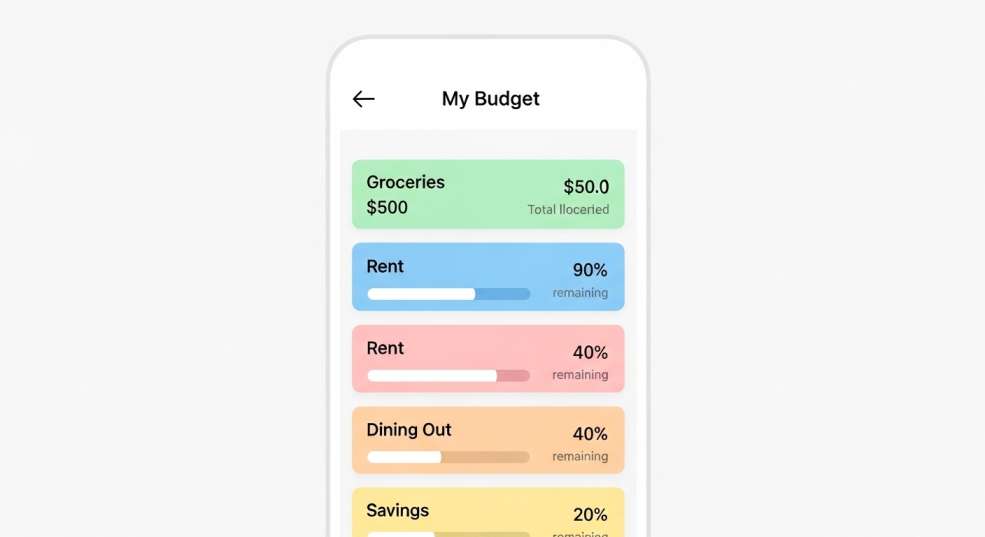
Let’s be real: most Canadians rarely carry cash. Most of us like to use cards for some purchases. If that’s the case, you can use an app like YNAB (You Need A Budget), one of the most popular envelope budgeting apps. You can also create your own version using a Google Sheet or Excel sheet. PiggyBank
Here are the three most popular digital adaptations for Canadians:
Option 1: Envelope Budgeting Apps. YNAB costs approximately $14.99 CAD/month or ~$109 CAD/year and is widely used by Canadians. Many users report saving more than that cost within their first month. Other solid options include Monarch Money, Copilot, and the completely free, open-source Actual Budget.
Option 2: Multiple Bank Accounts as Digital Envelopes. The envelope system 2.0 uses both cash and online bank accounts as savings stashes, involving setting up several electronic savings accounts — your digital envelopes — at your bank and transferring money from your main checking account. MoneySense Tangerine and EQ Bank are particularly popular among Canadian frugal living enthusiasts because they offer multiple high-interest savings accounts with no monthly fees. Naming accounts “Vacation Fund,” “Car Repair,” and “Christmas Gifts” creates exactly the psychological separation that makes this method work.
Option 3: A Simple Spreadsheet. A Google Sheets or Excel template with envelope categories as rows, allocations, and a running spending tally updated weekly costs nothing and gives you total control. Search “zero-based budget template Google Sheets” for dozens of free options.
Real Canadian Example: How the Okafor Family Turned Things Around
Meet the Okafor family — a composite scenario built from patterns commonly seen in Canadian personal finance communities.
Priya and James are a dual-income couple in Toronto with two kids. Their combined take-home is $7,200/month. They started the envelope method in January 2025 after realizing they were consistently running a $400–$600 monthly deficit with no idea where the money was going.
Their biggest discovery? They were spending over $1,100/month on food — $750 at grocery stores and roughly $350 on DoorDash, Uber Eats, and restaurant meals. They had mentally budgeted $600 total. Creating separate “Groceries” and “Dining Out” envelopes — capped at $800 and $150 respectively — forced them to meal plan more seriously and cut their food delivery habit in half within two months.
The second revelation was irregular expenses. They had no “Car Maintenance” envelope, so when their brakes needed replacing in February ($680), it came as a genuine financial shock. After adding a $75/month sinking fund for the car, that kind of expense became expected and planned for.
By month six, they had eliminated their monthly deficit, were contributing $500/month to their TFSA, and had funded a vacation envelope for a trip to Banff they’d been loosely “planning” for three years but never saved for.
The moral: the envelope system didn’t change their income. It changed their awareness — which turned out to be the problem all along.
Envelope Budgeting vs. Other Popular Methods: A Direct Comparison
TABLE 2: Envelope Method vs. Other Budgeting Approaches for Canadians
| Budgeting Method | Best For | Key Strength | Key Weakness | Canadian App Support |
|---|---|---|---|---|
| Envelope Method | Overspenders, visual learners, beginners | Tangible, hard spending limits by category | Can feel inflexible; awkward with cards | YNAB, Actual Budget |
| 50/30/20 Rule | Simplicity seekers | Easy to remember, minimal setup | No granular category control | Most bank apps |
| Zero-Based Budgeting | Detail-oriented planners | Every dollar intentionally assigned | Time-intensive; requires monthly work | YNAB, Monarch Money |
| Pay Yourself First | Savers and investors | Savings are guaranteed; rest is flexible | Doesn’t address spending habits | Automatic transfers |
| Bare-Bones Budget | Aggressive debt repayment | Maximizes debt payoff speed | Unsustainable as a long-term system | Spreadsheets |
The envelope method shares DNA with zero-based budgeting — both assign every dollar a purpose. The key difference is the physical or categorical separation that makes limits feel real.
Does the Envelope Method Work for Variable Income?
Self-employment, freelancing, gig economy work, and seasonal industries are extremely common across Canada. If your income fluctuates month to month, the envelope method still works — with one deliberate adjustment.
Budget based on your lowest expected income month, not your average. This creates a base budget that always functions. Use your lowest consistent monthly income if your earnings fluctuate. This prevents overestimating what you can allocate. Gotrade
In higher-income months, run a predetermined “windfall protocol”: decide in advance what percentage of extra income goes to savings, what tops up underfunded envelopes, and what you’re allowed to spend freely. Making that decision ahead of time — not in the moment when the money feels abundant — prevents lifestyle creep from quietly erasing your good months.
The Honest Downsides: When Envelope Budgeting Isn’t the Right Fit
No system is perfect. Envelope budgeting has strengths and limitations. PNC Here’s what to know before you commit:
It requires upfront effort. Reviewing statements, mapping spending categories, and calibrating allocations takes a few hours in the first month. It’s genuinely worth it, but it isn’t a five-minute fix.
Cash handling is increasingly inconvenient. In Canada’s tap-heavy retail environment, managing physical cash for every spending category is impractical for most people in 2026. The digital adaptations address this, but they require consistent tracking discipline to work.
It doesn’t handle fixed expenses elegantly. Traditional envelope budgeting often overlooks fixed expenses like rent, mortgage, utility bills, and other regular payments. Actual Budget Leave those on autopay and focus your envelopes on variable, discretionary categories where your behaviour can actually make a difference.
It can feel punishing without a buffer. If every envelope is packed to the penny and an unexpected cost hits, it can feel like the whole system is collapsing. The fix: always include a “miscellaneous” or “buffer” envelope containing 3–5% of monthly income to absorb small surprises without requiring category raids.
Key Takeaways: Does the Envelope Budget Method Still Work in 2026?
The short answer is yes — emphatically yes — but with important, practical caveats.
The envelope method works best when adapted to your actual lifestyle. For most Canadians in 2026, that means going digital with apps or sub-accounts rather than stuffing physical envelopes with cash. The core principle — giving every dollar a job before you spend it — is as powerful today as it was in your grandmother’s kitchen.
It’s especially relevant right now because Canadian households are under genuine, widespread financial stress. One in two Canadians feel that debt payments have made essentials at least somewhat harder, with common coping behaviours including shopping at multiple stores to chase deals (55.8%), buying less meat and protein (49.1%), and using coupons more than before (49.1%). Spergel In that environment, having a clear, category-by-category view of your money isn’t optional. It’s a survival strategy.
The envelope system won’t solve structural problems like unaffordable housing or stagnant wages. But it will stop the “mystery deficit” — that maddening end-of-month confusion about where your paycheque actually went. For most households, eliminating that confusion alone is worth far more than the hour or two it takes to set up.
Pull three months of bank and credit card statements. Add up what you actually spent in each category. Compare that to what you thought you were spending. For most people, that gap is the real budget problem — and the envelope method is exactly what closes it.
💡 HERE’s YOUR NEXT STEP

Frequently Asked Questions
Is the envelope method good for paying rent and bills in Canada? It works best for variable spending categories like groceries, dining, and entertainment. Leave fixed bills (rent, phone, internet) on autopay and focus your envelopes on the categories where your spending actually varies month to month.
What’s the best free budgeting app for Canadians using the envelope method? Actual Budget is free and open-source, using the envelope/zero-based approach. YNAB is the gold standard but costs approximately $109 CAD/year. A free Google Sheets zero-based budget template — easily found with a quick search — is also an excellent no-cost option.
Can I use the envelope system with a credit card to earn rewards points? Yes — many experienced envelope budgeters use credit cards for spending but track purchases against their digital envelope limits and pay the full balance every month. If you’ve previously struggled with credit card debt, use cash or debit while you build the habit first.
How long before the envelope method produces real results? Most people gain meaningful spending insights in month one and feel genuinely in control by month three. The system gets more accurate over time as your category allocations stop being guesses and start reflecting your real patterns.
This article is for informational purposes only and does not constitute financial advice. For personalized guidance, consult a Certified Financial Planner (CFP) in Canada.
Sources:
- Statistics Canada – Survey of Household Spending 2023
- Statistics Canada – Average Canadian Grocery Bill Analysis (July 2025)
- CollectorHQ – Canada Household Debt Tracker 2026
- Spergel – Grocery Debt Report 2026
- MoneySense – Envelope Budgeting 2.0
- PiggyBank.ca – Envelope Budget System for Canadians
- Actual Budget Documentation
